A 10 x 10 ft Hardtop Gazebo Is a Maintenance Decision Before It Is a Discount
-
Is a 10 x 10 ft hardtop gazebo the right footprint — or the wrong one?
-
What the 10 x 10 ft footprint actually decides for you
-
Hardtop shell or canopy cover — which replacement path are you buying?
-
The pre-buy decision matrix: five checks before you commit
-
Does winter belong in the purchase decision, or in the bookkeeping afterwards?
-
The rule: buy the footprint you can maintain, not the one on sale
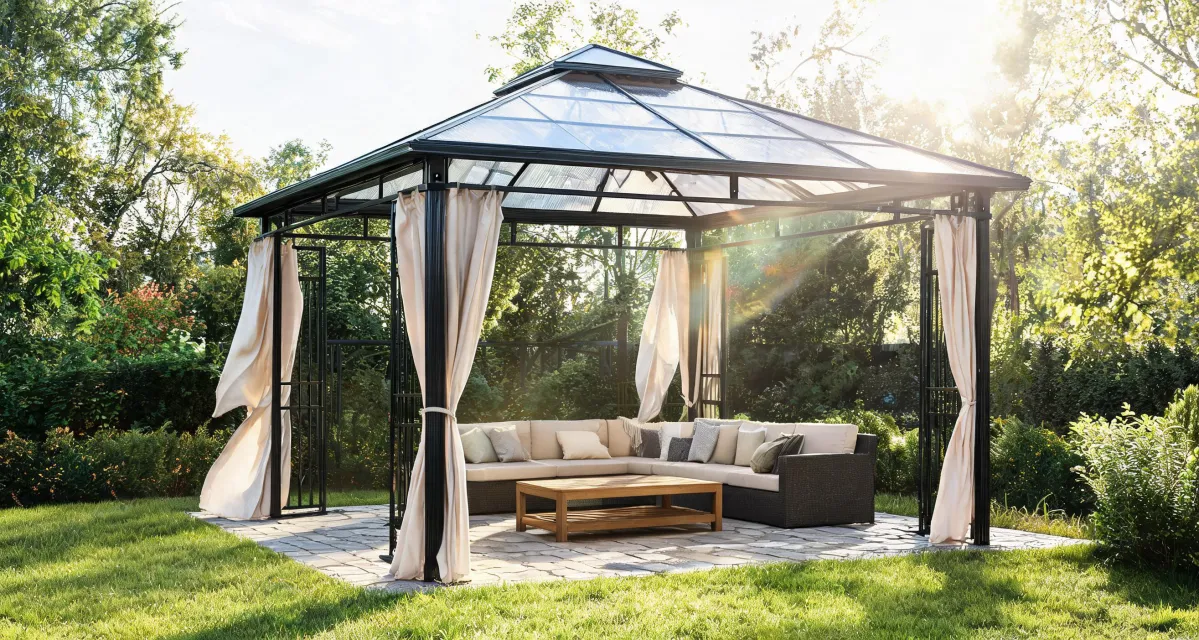
Two buyers walk onto the same patio with the same tape measure, and only one of them ends up with the right structure. The first buys a banner: a hardtop gazebo at a steep seasonal discount, assembled over a weekend, admired until the first winter bends a panel that cannot be replaced. The second reads the catalogue instead of the price tag, and notices that the brand selling the gazebo lists its Replacement Cover Finder and Floor Frame Kit Finder at the same navigation level as the gazebos, next to winter gazebo covers and wall-mounted models. That layout is the tell. The real dilemma is not whether a ten-foot hardtop looks good or whether the markdown is genuine; it is whether the footprint fits the life on that patio, and whether the parts path outlives the first summer. Both readings are defensible. Only one survives year three.
Is a 10 x 10 ft hardtop gazebo the right footprint — or the wrong one?
The promotional layer of the site makes the first reading easy to justify. Gazebos, solariums and carports are advertised at up to 60% off with a limited-supply caveat, while separate slides push 20% off carports and a 25% price drop on another line. A shopper can be forgiven for concluding that the decision has been made on their behalf. But a sale answers a question about timing, never about suitability: it says when a structure is cheap, not whether a ten-foot footprint clears the furniture, the property line and the patience required to re-tension a cover every few springs. Restated as the question that actually governs the purchase, the choice narrows: do you want a shaded table for four that you can measure, anchor and re-cover, or a structure you selected because its banner was the loudest one on the page? The discount is a date on a calendar. The footprint is a fact about the yard — and facts do not go on sale.
Two tests follow from that, and only one of them can be run in a store aisle. The first is arithmetic: post-to-post dimensions measured against the furniture you already own. The second is administrative: whether the model has a replacement cover and a base plan you can actually obtain. Buyers who run the arithmetic and skip the second test tend to own a gazebo, briefly.
What the 10 x 10 ft footprint actually decides for you
A ten by ten footprint sounds self-explanatory until it meets actual furniture. The nominal measurement describes the roof line, not the floor you can use: posts take the corners, bracing and overhang eat the edges, and the clear rectangle inside is noticeably smaller than a hundred square feet. A four-seat dining set — a 42- to 48-inch table with chairs pulled out two to three feet per side — already occupies something close to eight or nine feet once people sit down. That leaves a narrow walkway on two sides and almost nothing at the corners, which is why the same structure feels generous in a showroom photograph and cramped on the third evening you actually use it. The catalogue itself hints at this: the same listing drawer holds wall-mounted gazebos and canopy replacement covers, because footprint and mounting are the first questions the product line asks a buyer to answer.
Read the site's product hierarchy as a specification and it says what kind of object the buyer is getting. Alongside the gazebos sit floor frame and base kits, roof strengthening kits, winter gazebo covers and canopy replacement covers — categories that exist only because the structure is expected to need a foundation, a re-skin and an off-season rest. That is a different philosophy from a pop-up canopy, where the fabric is the product and the frame is a set of poles. Two units can both measure ten by ten and behave nothing alike in year four: one accepts a replacement cover and a staked base, the other goes to the curb when the first panel cracks. The practical consequence is that size comparisons across types are close to meaningless. What you compare is which replacement parts exist for the specific model, and whether the base plan is specified or improvised after delivery.
The ten-by-ten answer therefore holds under conditions, not in general. It works when the seating target is four adults at a table, when the patio leaves two to three feet of clear buffer on the open sides for chair pull-out, when the structure sits clear of the fence and property line, and when the surface can take an anchored base rather than a weighted one. It stops working when a lounge set has to share the space with dining, when six places are needed twice a year, or when the patio is a narrow strip where the posts land in the middle of the walking path. The honest conclusion in those cases is not that a ten-foot hardtop is a poor product. It is that a twelve-foot job is being asked of a ten-foot structure, and no markdown closes that gap.
Hardtop shell or canopy cover — which replacement path are you buying?
Which replacement path are you buying when you choose a hardtop? The brand's own framing answers that before any product page does. The replacement cover finder and the floor frame kit finder sit among the top-level tools, in the same tier as replacement cover kits for canopies and gazebos and a support line staffed seven days a week. Read plainly, the manufacturer treats the structure as a frame plus a renewable skin plus a base plus a seasonal cover, and builds a lookup for each. A fabric-first canopy travels the same toolset from the opposite direction: the cover is the wear item and the frame is the constant. The buyer's question is which of the two they are willing to maintain. Purchase price is a one-time number; the replacement path is recurring, and it decides whether year four is an order or a disposal.
Once a gazebo is understood as a maintainable system rather than a one-season purchase, the arithmetic changes. A hardtop with a findable replacement cover and a specified base kit has a service life set by the frame and the supply of covers; the skin becomes a planned expense instead of a failure that ends the product. A canopy whose cover size is not indexed anywhere is effectively disposable after two or three seasons, because the owner cannot confidently re-order the right skin. This is why the accessory category deserves closer reading than the specification table: the existence of a cover finder and a floor frame kit finder is evidence about intended lifespan. It also explains the presence of carport enclosure kits and roof strengthening kits in the same catalogue — accessories that make sense only if owners are expected to keep and modify the structure rather than replace it every few years.
The pre-buy decision matrix: five checks before you commit
Before committing to a ten-by-ten hardtop, five checks are worth running in order, and the order carries information. First, measure post to post rather than roof edge to roof edge, and compare that inner rectangle against the furniture you intend to seat. Second, walk the perimeter and confirm two to three feet of chair pull-out on the sides that matter; corners are the first casualty. Third, search the model in a replacement cover finder and confirm a cover is listed, because that single lookup predicts whether the structure gets repaired or replaced. Fourth, confirm whether a floor frame or base kit is specified for your surface — grass, gravel, decking and concrete each change the anchoring plan. Fifth, check the season path: whether a winter cover exists for the size, and how support works when a strap or a panel fails mid-season.
The five checks are ordered that way because three of them are irreversible and two are not. Footprint, base preparation and replacement availability are structural: the model and the site decide them, and no after-market improvisation rescues a structure that is one size wrong. Assembly, cover care and off-season storage are adjustable; a buyer can improve them over time with a better anchor set, tighter tie-downs or a properly stored cover. That asymmetry is what the catalogue layout quietly encodes. Wall-mounted gazebos, floor frame and base kits, roof strengthening kits and winter covers exist as separate categories precisely because site conditions and maintenance habits vary while the frame does not. Working through the checks in order of reversibility keeps a photograph from locking in a decision that the yard will have to live with. Reversing a colour preference costs a weekend; reversing a footprint costs a return.
The checklist is not meant to be applied mechanically, and a few situations flip it. Where the site is rented or the household expects to move within a couple of years, the replacement path matters less than disassembly and resale, and a lighter structure with fewer parts usually wins. Where the patio is shaded by trees or already roofed, the hardtop premium buys less than it would in full sun. Where the intent is to re-skin the frame with a generic tarp or a third-party cover, the specific cover finder stops being a guarantee; covers are cut to fit, and one that cannot be tensioned properly pools water and shortens frame life. In each case the right answer may be a smaller footprint, a wall-mounted unit, or nothing at all this season. None of those is a compromise on quality; they are corrections of fit.
Does winter belong in the purchase decision, or in the bookkeeping afterwards?
Does winter belong in the purchase decision, or is it housekeeping to handle later? The catalogue answers by shelving winter gazebo covers alongside the gazebos themselves, next to canopy replacement covers and carport enclosure kits. That placement speaks to the half of the year the structure is not in use, not to where it gets stored. A buyer who has never thought about standing water in a sagging cover, snow sitting on a roof panel, or a frame left under a wet sheet is not choosing a cheaper product. They are postponing a decision the product line already anticipated, and paying for it in the third spring, when the fabric has stiffened and the frame has started to discolour at the joints.
Support availability is the quietest signal on the site and one of the most useful. The brand advertises help seven days a week from a US-based team, an unusual commitment for a product used a few months a year. Read as evidence rather than marketing, it implies a service life long enough to justify staffing for problems that surface after the sale: a missing part, a torn panel, a replacement cover that arrives in the wrong size. For a buyer weighing a four-figure structure, that changes the risk calculation. The question stops being whether the gazebo survives one summer and becomes whether anyone will still answer the phone when the second cover needs ordering. Manufacturers who expect a single season of ownership do not build that kind of support line, and they rarely publish it beside the finders. It is a small line of text with a large implication for how long the structure is meant to last.
The rule: buy the footprint you can maintain, not the one on sale
The promotional numbers are real, and they are also recurrent. Gazebos, solariums and carports appear at up to 60% off under a limited-supply label, carports at 20% off, another line at a 25% price drop: a rotating set of offers that different shoppers will encounter at different prices for the same structure. That rotation is the strongest argument against letting the discount make the decision. A promotion tells you the timing is good; it says nothing about whether a ten-foot hardtop fits the patio, whether the frame can be anchored into something solid, or whether a replacement cover will still be orderable in three years. The savings are real money and, on a four-figure purchase, they matter. They are also the smallest number in the calculation. Everything else in the column — footprint, base, cover, storage — is decided once and then repeated every season.
The rule that resolves the opening dilemma is short enough to use in a driveway with a tape measure: buy the footprint you can maintain, and treat the discount as a trigger rather than a reason. Measure the inner rectangle first. Confirm that a replacement cover exists for the specific model and that the base plan suits the surface. Check that a winter cover is available for the size, and note how support is staffed in case a part fails. If all four hold, the 60% off banner is an ordinary good deal and can be taken without hesitation. If one fails, the better answer is a smaller, wall-mounted or differently anchored structure, or waiting a season. Sales rotate on a schedule. The yard does not. That reversal — using the calendar to time a decision you have already made, rather than to make it — is the whole of the argument.
What separates the two buyers on that first patio is sequence, not budget. One measured the inner rectangle and confirmed the parts path before looking at the price; the other let the banner select the structure. The rule that follows is narrow and repeatable: a hardtop gazebo is a base, a frame and a renewable skin, and the version worth owning is the one whose cover, anchoring plan and off-season storage you can picture three summers from now. If you can picture all three, the sale is a bargain. If you cannot, a different footprint is the answer, and no discount changes that.

Ingrid Falk
Ingrid Falk is an outdoor living products analyst specializing in fences, pergolas, gazebos, canopies, greenhouses, shade sails, patio sets, outdoor sofas, and weatherproof cushions. She uses ISO 4892-2 and ASTM G154 weathering methods while comparing UV color change, coating adhesion, corrosion resistance, frame load, joint stability, water shedding, and dimensional movement. Her work helps garden retailers, project buyers, and hospitality operators select structures and furniture suited to wind exposure, climate, installation method, maintenance, and expected occupancy.