Buying a Steel-Roof Gazebo: The Repair Path Matters More Than the Material
-
A Galvanized Steel Roof Isn't a Maintenance-Free Label
-
Two Failure Modes, and Only One of Them Lives in the Roof
-
The Real Acceptance Test: Are the Replacement Parts Still on the Shelf?
-
Three Situations Where the Steel Roof Is the Wrong Answer
-
The Verdict: Pay for a Predictable Repair, or Buy Big and Soft
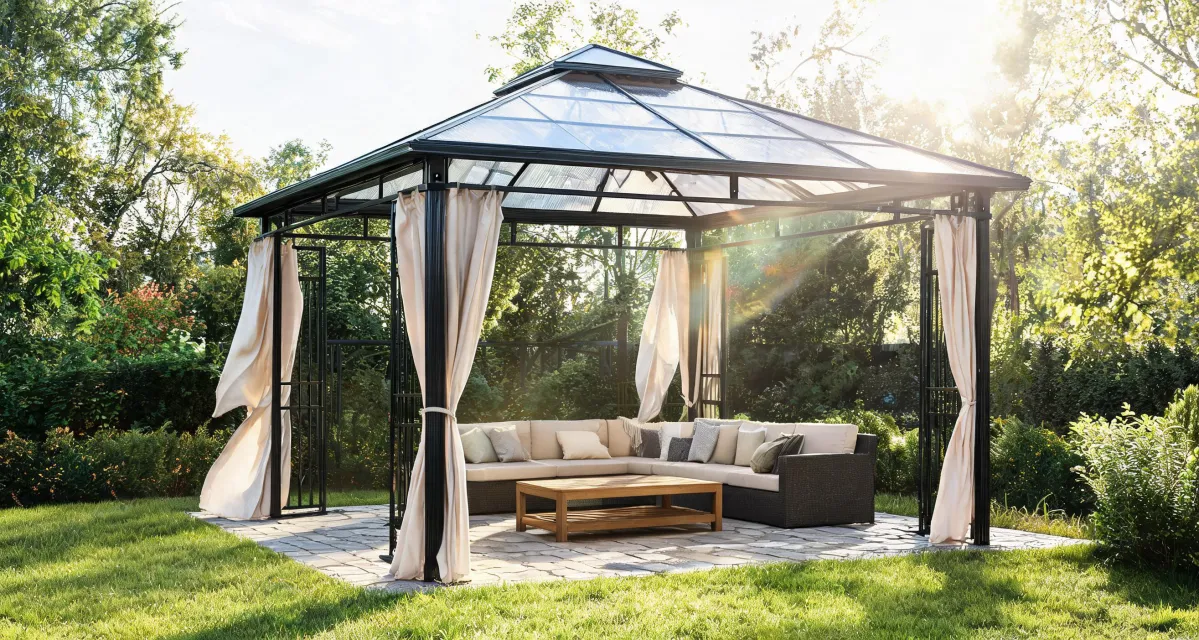
The question worth starting with isn't whether the Messina's roof is steel. It's what happens the first time something on it breaks. A galvanized steel roof doesn't really mean maintenance-free — it means the failures arrive as replaceable parts instead of as an entire structure you drag to the curb. That's a smaller claim than the marketing word suggests, and it happens to be the one I'd pay for. Read steel roof as buy it once and forget it and you'll budget for the wrong thing entirely: you'll compare roof panels and skip the two costs that decide your next several years — whether replacement pieces stay available, and whether your site can carry the weight and stay properly anchored. So let's argue about what you're actually buying.
A Galvanized Steel Roof Isn't a Maintenance-Free Label
Look at how this seller organizes its own site and the argument gets concrete. Sitting in the top-level navigation are a Replacement Cover Finder and a Floor Frame Kit Finder, right alongside a support line running seven days a week for US-based customers rather than tucked away on a warranty page. A seller that builds finders for replacement covers and floor frames is telling you something structural: it expects these products to be maintained and re-fitted rather than discarded when one piece ages. That reframes my decision. I'm not shopping for a roof that will never fail — no outdoor structure clears that bar through rain, sun, snow and wind. I'm shopping for one where a failure has a part number and a person to call. Those two finders and that support line are the closest thing to that promise I can verify from a product page.
The same page is where I'd put a limit on that promise, though. That support line is a reachability signal: a bent bracket or a torn cover becomes a conversation instead of a dead end, and it shows the company treats ongoing service as part of the product. It does not tell me what a replacement part costs, how long it stays stocked, or whether the model I want shares parts with the models that came before it. Support answers whether I can get help. It does not answer whether this specific part still exists in year four. Those are different questions, and the second one moves my wallet. So I treat the support line as insurance against a total loss, not as proof that a steel roof eliminates maintenance.
Which leaves the question that actually decides the purchase: what breaks first, and what does repairing it cost? If a steel roof moves the failure somewhere cheaper and slower than a fabric roof does, the premium is justified. If it merely moves the failure to parts I can't buy or can't diagnose, the premium is a fee for a nicer-looking ceiling. So the next thing I want is a failure map — one for the fabric-top gazebos this design competes against, and one for the steel structure itself. The whole value story depends on which failures I end up paying for, and how often.
Two Failure Modes, and Only One of Them Lives in the Roof
Start with the failure everyone in this category recognizes. A fabric-covered gazebo fails from above, usually in one of two ways: rain collects in a sagging panel until the weight pulls the top down into a bowl, or the fabric finishes its life under ultraviolet light and tears at a seam or a corner tie. Neither failure is exotic, and both are the reason Replacement Cover Kits, Canopy Replacement Covers and Winter Gazebo Covers sit on this seller's menu as standing categories next to the gazebos themselves. That is the tell: on a soft-top structure, the cover is a consumable. The frame may outlive two or three covers, and the cover is a repeat purchase — the only open questions are how expensive and how available that repeat is.
A solid roof shifts the wear to different places: the structure itself, the points where it is fastened down, and the integrity of the coating that keeps moisture off the steel. That is a different maintenance rhythm. Instead of one large event — the top is done, order a new one — you get small inspections: a fastener that needs re-tightening, an edge where the finish has been scraped, a joint worth checking before winter. Here I have to be careful not to over-claim. The pages I can check do not give model-level figures for the Messina: no coating thickness, no panel gauge, no wind or snow load rating, no stated warranty term. Anyone quoting those numbers for this model is inventing them. What the evidence does support is qualitative: failure becomes something you inspect and address locally, rather than a whole surface reaching end of life at once.
Translated into money and Saturdays, the two structures fail on different schedules. A soft top tends to fail in one big, obvious, eventually-certain replacement purchase, preceded by years of looking slightly worse. A steel top tends to fail in smaller, more frequent, more diagnosable ways. Which is cheaper depends on two things I refuse to assume: what the replacement cover costs when I need it, and whether the small steel fixes stay possible because parts and support exist. Steel is a different failure shape, not a promise of fewer failures. That distinction is the whole argument against treating a material label as a verdict.
The Real Acceptance Test: Are the Replacement Parts Still on the Shelf?
Here is the rule I would actually buy by. Before comparing roof materials, check whether the replacement pipeline for that specific model is a catalog category or a leftover listing. On this seller's pages the pipeline is broad and parallel: Replacement Cover Kits, Canopy Replacement Covers, Winter Gazebo Covers, Floor Frame and Base Kits, Roof Strengthening Kits, Carport Enclosure Kits and Walls, plus wall-mounted gazebos, all presented as standing product lines rather than one-off accessories. That breadth matters because it converts a future failure into a price you can look up today. When the cover, the winter cover, the floor frame and the base kit are all named products with finders attached, a torn top or a rotted floor frame is a purchase decision with a number on it, not an excuse to replace the whole gazebo. When they are not, the steel roof's advantage is theoretical.
The counter-case deserves sitting with, because it is the one that turns this purchase into a trap. If the parts channel thins out — the model discontinued, the kit no longer stocked — a steel-roof unit locks the loss into the whole structure: you cannot cheaply re-skin it the way a fabric gazebo gets a new cover. The same seller pages that list all those accessory lines also run hard promotions: gazebos, solariums and carports marked up to 60% off as limited supply, carports at 20% off, one line at a 25% price drop. Deep, rotating discounts are a signal that inventory and product lines move. They are not a promise that the replacement cover for my model will be on the shelf in three winters.
So the pre-purchase checklist is short and dull, which is exactly why it works. Search the replacement cover finder for the model and size you want. Confirm whether a winter cover is included or sold separately. Confirm whether the floor frame and base kit are separate line items you will want anyway. Then price one full round of replacements into the purchase and compare that total against a fabric option plus one eventual cover swap. That comparison is the one I trust. Everything else — coating, panels, finish — is a detail inside a decision that is mostly about how the thing gets serviced once it starts to age.
Three Situations Where the Steel Roof Is the Wrong Answer
Now the other half of an honest opinion: the situations where I would not buy the steel version. First, when usable size beats every other consideration. If the area you are shading is large and the budget is fixed, a cheaper fabric-roof gazebo in a bigger size delivers more shade per dollar today, and you take on the cover-replacement risk knowingly. Second, when the site cannot take the structure. A steel roof adds weight up high, which raises the bar for anchoring and for the surface underneath; a soft, uneven or rented patio is a real constraint, and a structure you cannot anchor confidently is worse than a lighter one you can. Third, when your horizon is short — if you expect to move, or you are treating this as a two- or three-season setup, the repairability premium has less time to pay you back.
It also helps to remember that a steel gazebo roof is not this company's default answer — it is one answer among many. The same catalog covers steel carports, wall-mounted gazebos, portable greenhouses, high-tunnel greenhouses, canopies and shade tarps, and the about page frames the whole operation as a global supplier of outdoor products challenging people to rediscover the outdoors, not as a single gazebo line. Read that way, the material question dissolves into a siting question: what does your yard, your wind exposure, your winter and your patience for maintenance actually call for? A wall-mounted gazebo against a house and a freestanding steel-roof unit solve different problems. Steel wins on repairability; it does not automatically win on fit.
For a buyer, every do-not-buy signal reduces to the same trade. You give up footprint and flexibility, and you take on installation and anchoring work, in exchange for a structure whose failures are more inspectable and more fixable. That trade is good when the gazebo stays in one place and gets used hard for years. It is bad when the gazebo is really a shade solution you are renting space for. No product page will tell you which of those you are doing. The honest version of this decision starts with how long the thing is staying where you are putting it, and how much of the repair work you are willing to handle yourself.
The Verdict: Pay for a Predictable Repair, or Buy Big and Soft
My verdict: buy the steel-roof version only when two conditions hold — the replacement parts for that model are live, stocked products, and your site can carry the structure's weight and anchoring demands. Under those conditions the premium buys something real: a failure with a price and a supplier instead of a failure that ends the gazebo. Where either condition fails, buy the bigger soft-top, budget one cover replacement, and treat that as the honest cost of size. What you are paying for with a steel roof is not a permanent roof; it is the ability to repair a breakdown in steps. The promotional structure around these products makes the point for me: with gazebos, solariums and carports discounted by as much as 60% in limited-supply sales, the price you pay is a moving target, while the parts channel stays something you can verify before you buy.
Two boundaries keep that verdict from hardening into a slogan. First, do not anchor the decision to the discount. Discounted inventory marked as limited supply is a temporary condition, and a banner advertising up to 60% off this season says nothing about what a replacement cover costs two winters later, or whether the model survives the promotion cycle at all. Second, the evidence I am leaning on is categorical rather than model-level: the pages I can check confirm that replacement covers, winter covers, floor frames and base kits are standing categories, and that support runs seven days a week, but they do not give Messina-specific coating, panel, load or warranty figures. I would reverse this verdict the moment those parts categories stop appearing in the catalog. Until then, check the parts, check the ground, and price the repair before you pay for the roof.
Nothing about a galvanized steel roof stops the weather from working on your gazebo. What it changes is who pays when the weather wins a round. With a fabric top, the answer is one large replacement, priced by the market for that cover and made uncertain by whether the cover still exists. With the steel version, the answer is smaller, more local and checkable, provided the parts are still listed and the structure is anchored properly on ground that can hold it. That is the whole premium. Judge it on the parts pages and on your patio rather than on the word galvanized, and the decision stops being about material claims and becomes about which failure you would rather pay for.

Ingrid Falk
Ingrid Falk is an outdoor living products analyst specializing in fences, pergolas, gazebos, canopies, greenhouses, shade sails, patio sets, outdoor sofas, and weatherproof cushions. She uses ISO 4892-2 and ASTM G154 weathering methods while comparing UV color change, coating adhesion, corrosion resistance, frame load, joint stability, water shedding, and dimensional movement. Her work helps garden retailers, project buyers, and hospitality operators select structures and furniture suited to wind exposure, climate, installation method, maintenance, and expected occupancy.