Running a Sojag Olan Solarium Through Four Seasons: Roof and Doors
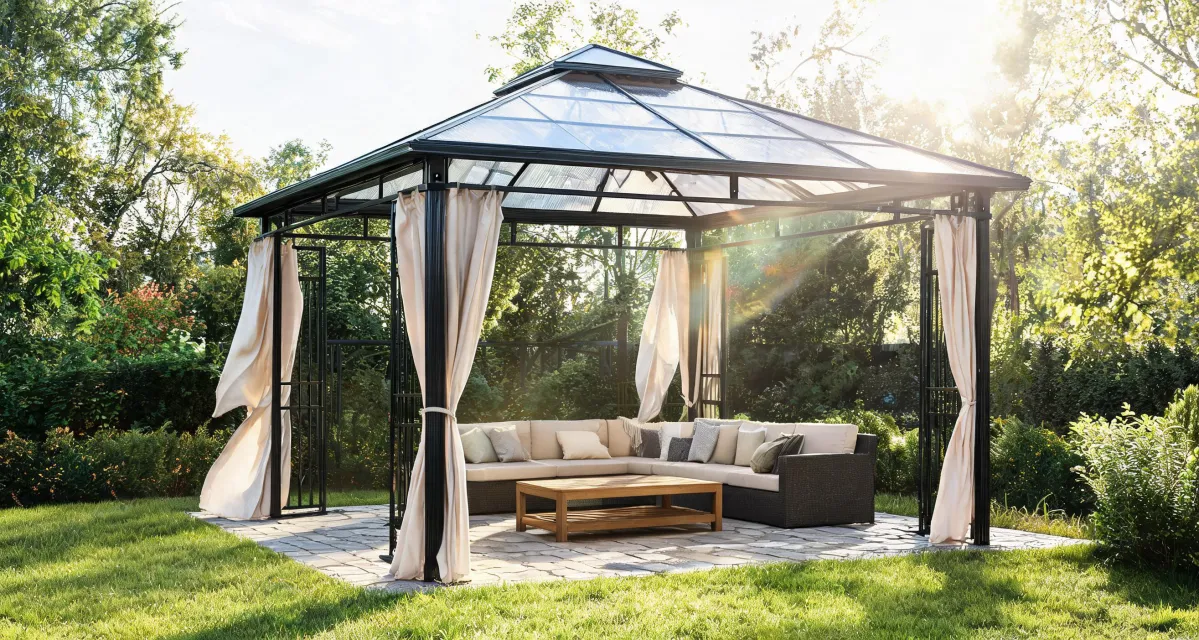
Mid-November, and I am standing on a wet 17 by 10 foot deck pad behind a kitchen door, tape measure in one hand and a printed listing in the other, running the same math a lot of buyers run: another screen room at roughly half the money, or the Sojag Olan at 17 x 10 x 10 ft and hope the extra buys a longer season. The pad is level, both door openings face clear ground, and there is standing water where the downspout dumps, which already tells me where I will be clearing snow in March.
The four-season claim on the Olan rests on the double roof design and the two double sliding doors moving air and shedding weather. It is not an insulation claim: there is no R-value in the spec, no furnace, no sealed living space. A buyer who copies sunroom habits and keeps everything shut tight ends up with an oven in July and a wet, heavy roof in March, so setup and the seasonal routine, not the heater bolted inside, decide whether this thing is usable in January.
What Four-Season Protection Means on the Olan
The manufacturer's own line for the Olan promises protection from the sun, rain, mosquitos and even snow, all while being surrounded by the beautiful outdoors. Read that literally. Every item on the list blocks something from reaching you while keeping your view of the yard, which means this is an envelope and circulation claim, not a thermal one. Nowhere in the spec does anyone promise a temperature.
Picture the actual use: a kitchen-door deck where the owner wants coffee at 7am in March without wind cutting across, and dusk in July without mosquitos on the ankles. Four-season here means you stay outside longer in every season than you could on an open patio, because the enclosure keeps weather and insects on the far side of the glass. That single reframe decides every later choice, from how you anchor the base to how you run the doors in July.
Why the Double Roof and Sliding Doors Do the Work
The design note is blunt about the mechanism: an impressive double roof design and 2 double sliding doors, allowing for additional air circulation. Start with physics. Because warm air rises and collects under the highest surface, the upper roof panel shades the lower one, and the gap between the two acts as a stack that pulls hot air up and out of the enclosure instead of letting it pool at head height.
The doors handle the other half. Because the two double sliding doors sit on opposite faces of the 17 by 10 ft footprint, opening both sets up cross-flow, which means air enters one side, crosses the seats and the table, and leaves the other side. A sealed solarium with a single roof and no cross-flow bakes by noon, and no wall thickness or glass tint fixes it.
Winter does not suspend the logic. Even in cold months, leave the roof gap clear, because trapped moist air condenses on cold aluminum and drips onto whatever sits below. That drip cycle, more than the cold itself, is what makes people give up on an enclosure.
Which Parts Decide How Long the Olan Lasts
The spec note says the sturdy aluminum structure and galvanized steel roof will last for years to come. For someone comparing lifetime cost against a screen room or a cedar pergola, the useful translation is which part actually retires first. Because aluminum does not rust, the frame is not the piece that ends the structure's life. Galvanized steel protects itself with a zinc coating that sacrifices itself before the steel underneath does, which means the roof coating is the clock you are really buying.
The other consumable is mechanical: the rollers and tracks on the two double sliding doors. A dragging door is the usual first failure on any sliding enclosure, and a set of rollers costs a fraction of a glazed panel, so inspect the tracks each spring and replace wheels before you price new glass. Compare that to a screen room, where the mesh is the clock, sagging and tearing at the fasteners with no invisible patch, or a cedar pergola, where rot at the post bases starts the clock.
One source note worth keeping: the official product domain is shelterlogic.com, and that is where you read the spec for this exact model, rather than trusting a marketplace listing that may describe a different size or last season's door hardware.
Assembling the Olan in the Right Order
Everything here is sequence, and the order exists because each stage sets the tolerance for the next. Start with the pad: four inches of compacted crushed stone over filter fabric, or concrete footings at the marked anchor points, worked until a spirit level shows no rock anywhere. The key point at this stage is that out-of-level ground twists the frame, and a twisted frame is exactly what makes sliding doors bind later.
Set the base plates and anchors next, and check the diagonals for square before you tighten anything down. Square first, tighten later, because a frame pulled square after it is bolted fights every panel you add.
Raise the frame walls and bolt the panels, keeping the fasteners loose until every wall is standing. One over-tightened corner pulls each following panel out of line, and you will chase that gap all the way around the structure. The glazed panels are awkward rather than heavy, so plan a second pair of hands and a calm morning, because a loose panel catches wind fast.
Then the roof, in its own order: main beams, lower roof panel, and finally the upper roof panel that creates the double-roof gap. Keep that vent gap open. The tempting move is to seal it to keep rain out, and that single decision switches the stack effect off for the life of the unit.
Hang the two double sliding doors last and adjust the rollers. The doors are the tolerance-sensitive part of the whole build, so they go on after the frame has stopped moving, not before.
Opening and Closing the Solarium by Season
In July, both double sliding doors open and the upper roof vent left clear. That combination is the cross-flow path the design was built around. Closing everything to keep the cool air in does the opposite and traps heat, so a habit borrowed from the house does not transfer here.
Through the shoulder months, one double door open halfway with the same vent open gives shelter from wind without baking the interior, which is the sweet spot this structure is genuinely good at.
In winter, close the doors to block snow and wind, but leave the roof vent clear if you run any heater, because the stack effect is what carries moisture out and away from the aluminum. After a snowstorm, clear the roof from outside with a roof rake rather than letting it pile and refreeze, because weight and ice are what damage the roof panels.
How to Tell Your Olan Is Set Up Right
A correctly adjusted double sliding door moves with two fingers and stops without a gap at the jamb. If it needs a shoulder to close, the frame is out of square, not the door.
Square shows up in the diagonals: measure corner to corner across the frame and the two numbers should land within about a quarter inch of each other. Level shows up on the base plates, where a spirit level should sit flat with no rock. A rocking base means the pad was not compacted, and it will telegraph into the doors within a season.
With both doors closed, there should be no daylight line at the top and bottom tracks. Mosquitos enter through the smallest gap, and blocking them is the whole point of the enclosure.
On a cold morning after sun hits the roof, snow should slide off within a day rather than sit and refreeze. Snow that stays put is the sign the double-roof shedding is not doing its job.
Before you order, walk the site once and confirm two things: that both double sliding doors can open onto clear, flat ground, and that snow can slide off the long sides of the roof instead of dumping into a wall, a fence, or the downspout puddle. This is the one check that matters, because blocked airflow and trapped snow are the two failure modes that turn a four-season solarium into an unusable greenhouse, and if the site fails it, no upgrade on the unit itself saves it.

Mateo Rivas
Mateo Rivas is a garden watering and irrigation analyst covering drip systems, emitters, garden and soaker hoses, hose reels, sprinklers, nozzles, misting systems, and watering cans. He applies ISO 9261 test methods while examining emitter discharge, pressure compensation, flow uniformity, burst pressure, kink resistance, spray pattern, filtration needs, and water-use efficiency. He helps growers, landscapers, distributors, and homeowners size zones and select components for available pressure, planting layout, climate, water quality, and maintenance access.