A Galvanized Steel Roof Gazebo Makes a Load Claim, Not a Maintenance Promise
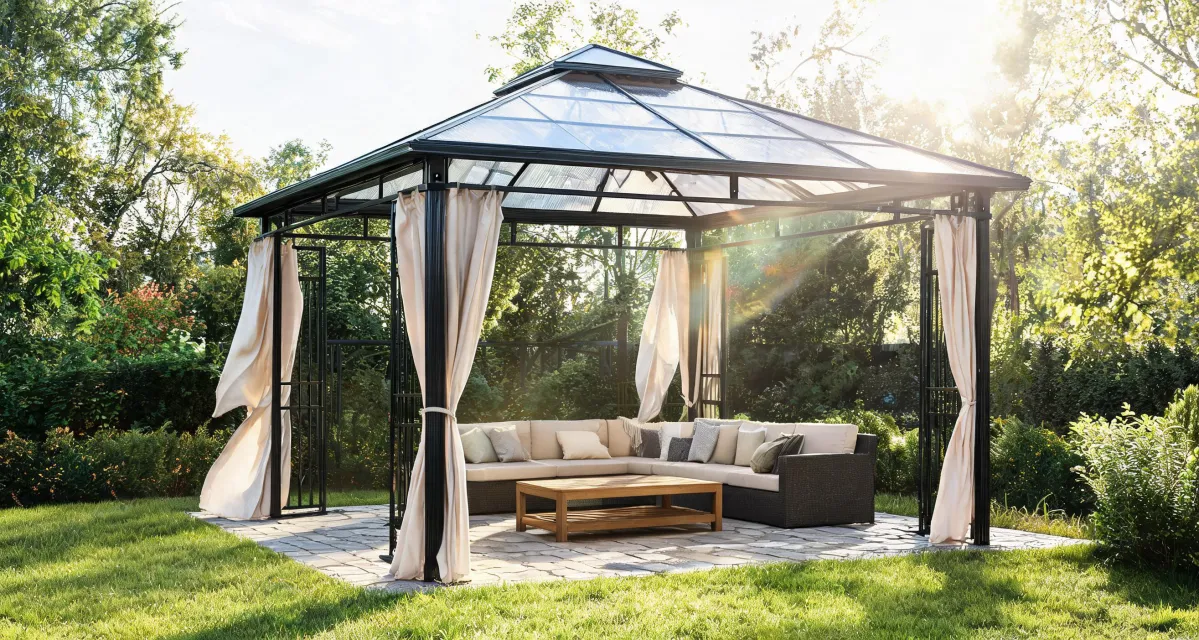
Search for this gazebo and you will meet the same phrase used as the headline selling point: galvanized steel roof. Most buyers read that as 'nothing left to do.' That is the most expensive misreading in this category. A galvanized steel roof is a statement about the frame and the load sitting on it, snow, wind, water, and about very little else. It says the panel will not rust through. It does not say the cover, the floor frame, or the anchors will last as long, and it does not mean you will never open a parts page again. What you are buying is a hard roof over several softer layers, and those layers are the ones with a service life.
A Steel Roof Promises Load, Not a Lifetime of Doing Nothing
Here is the argument worth testing: the harder question about a steel-roof gazebo is not whether the roof is galvanized, it is what happens underneath it. Two structures that look identical from the deck can differ by years of future cost, purely on whether the fabric, the base, and the reinforcement parts are still purchasable three winters from now. You might push back, since a buyer who keeps up with maintenance never runs into this problem. Fair, and that is precisely the point: 'keeps up with maintenance' is itself a commitment you take on when you buy the hardtop. A structure that asks nothing of you puts no obligations on you. That is not what is for sale here, and pretending otherwise is how a good purchase turns into a bad one.
The reason this misreading is so easy to fall into is that the storefront is actively pushing you toward it. The homepage slider runs a banner reading 'Gazebos, Solariums and Carports are up to 60% off (Limited Supply),' next to a 20% off Arrow carports slide and a ShelterTech 25% price drop. Three discount messages, one decision, and not one of them tells you whether the replacement cover for the model you are looking at will still exist in three winters. A discount is information about price. It is not information about the layer under the roof, and treating a 60% off banner as if it validated the roof material is exactly how buyers end up comparing the wrong spec. Discounts make a decision feel urgent. They do not make it complete, and the banner is doing its job either way.
So define the commitment properly. Buying a hardtop steel-roof gazebo commits you to three things: a frame rated to carry a solid panel, a seasonal routine you actually perform, and, the part nobody prints on the box, a supply chain for the layers that wear out. The same catalog that sells the structure lists Roof Strengthening Kits, Winter Gazebo Covers, Canopy Replacement Covers, and Floor Frame & Base Kits as products in their own right. That is not filler on an accessories page. It is the manufacturer stating, in product form, that the roof is the durable part and everything hanging off it is consumable. Once you accept that, the question stops being whether the steel roof is any good and becomes whether you can still buy the parts under it in year five.
The First Layer That Fails on a Hardtop Gazebo Is Not the Steel Roof
Picture a homeowner who treats the backyard as a second living room: gazebo up in spring, first winter behind them, and by February something feels off. The symptoms arrive in a predictable order once you know what to look for. The cover fabric sags under snow load and does not spring back. The floor frame's anchor points begin to shift, a give you can feel when you walk a corner. In a hard wind, the joints where the roof meets the posts develop a rattle you can hear from the kitchen door. The steel panel itself, meanwhile, looks exactly the way it did on delivery day. That sequence is not a coincidence. Scan the same catalog and you will find Replacement Cover Kits, Winter Gazebo Covers, Floor Frame & Base Kits, and Canopy Replacement Covers listed right alongside the gazebos and canopies they belong to. The manufacturer has already told you which pieces come back.
The mechanism is boring, which is exactly why people miss it. A roof panel is a static part: it does not move, it does not stretch, and galvanized steel is chosen specifically so weather does not eat it. The consumable layers are doing mechanical work. A cover is fabric under tension, so every snow load and every UV season relaxes it a little more. Floor frame and base kits carry the whole structure's load into the ground, and ground moves, through frost heave, drainage, a wet spring. A winter cover absorbs the worst of the accumulation so the rest of the structure does not have to. Read the catalog again and the logic is exposed: the base kits, the winter covers, and the replacement canopies are separate line items, not spares hidden in a support drawer. Products sold separately are products expected to be bought again. If the roof were the wear item, the replacement kits would be roof panels.
The Accessory Catalog Says More Than the Spec Sheet Ever Will
One detail should change how you compare these structures. Two search tools sit in the site header, before you have opened a single product page: a Replacement Cover Finder and a Floor Frame Kit Finder. Next to them, one plain line of service copy, '7 days a week US-based customer support!' That combination is not marketing filler. A manufacturer builds a finder tool when it expects a meaningful share of its customers to come back years later, holding a model number and looking for a replacement for something that wore out. You cannot run a finder for a part nobody buys. Support seven days a week matters because the failure you are calling about, a cover that tore in a storm or a base kit that shifted after a thaw, does not schedule itself for Tuesday at ten.
Put the two comparison paths side by side. Path A: you read roof material, compare panel thickness and coating, and buy whichever one sounds more substantial. Path B: you check whether that model's cover, floor frame, and reinforcement parts are listed and findable, and only then do you look at the roof. Path A feels rigorous because it involves numbers. Path B feels soft because it involves a search box. But consider what the company actually is: a self-described leading provider of outdoor products and solutions, running a catalog that spans gazebos, carports, sheds, greenhouses, and the accessories for all of them. A provider of solutions stays in business by supplying the parts. A provider of one-off products sells you a thing and moves on. Which of those holds your money for a decade is a question about the catalog, not the panel.
The obvious pushback: if they sell replacement covers and winter covers and floor frame kits, does that not mean the thing falls apart? Sometimes, yes, a thin cover on a light frame is a thin cover on a light frame. But the existence of a parts program is not evidence of poor quality. It is evidence that the product has layers with genuinely different service lives, and every durable category works this way. Cars have tires and belts. Houses have roofs and gutters. The honest version of the criticism is narrower: selling you these layers without saying at purchase which ones you will need, and roughly when, leaves you to find out the hard way. That is a communication gap, not a durability verdict. The defect sits in the buyer's comparison, not in the steel.
A Discount Rewrites the Payback Math
Now factor the discount in, because the numbers reshape the decision. The site currently rotates 'Gazebos, Solariums and Carports are up to 60% off (Limited Supply)' alongside a 20% off Arrow carports offer and a ShelterTech 25% price drop. Suppose the model you want lands inside that up-to-60% band. The question is no longer whether a hardtop is worth the premium over a soft-top canopy. It is how many replacement covers you can buy at this price before the hardtop stops being the cheaper path. Run it that way and the hardtop usually wins, but only if you can actually buy the covers. A 60% discount on a structure whose replacement parts you cannot locate is a discount on a single-life product. A 20% discount on a structure with a finder tool and a seven-day support line is a discount on a maintained asset.
Who should pull the trigger inside a promo window, and who should not? If you are the kind of owner who will register the model, save the order confirmation, and check the anchors and the cover every fall, a discounted hardtop is a straightforwardly good buy, because you are the customer the parts system was built for. If your plan is to install it in May and forget it exists, no discount fixes that; you will be the person writing the one-star review about a cover that 'failed,' when what failed was an assumption. There is also a scope boundary worth respecting. This company also bills itself as a leader in outdoor products and solutions, across a catalog spanning gazebos, carports, sheds, greenhouses, and shade products. But breadth is not the same as fit. If your yard takes serious wind or your winter is long and heavy, the honest answer may be that a hardtop is the wrong structure for you.
The Rule I Would Run Before Checkout
Here is the rule, and it takes about ten minutes to run. Step one: open the manufacturer's catalog and search your model against the replacement parts, meaning the cover finder, the floor frame and base kits, the winter covers, the roof strengthening kits. Step two: confirm those parts are listed as purchasable items and not as a support ticket you are hoping gets answered. Step three: only now read the roof spec. If step one or step two fails, the steel roof is irrelevant; you are buying a structure with an unknown service life and no plan for the second half of it. If both succeed, you are buying into a system, and the roof becomes what it should have been all along, a good reason to like the structure rather than the reason you bought it. Cover kits, base kits, winter covers, strengthening kits: run the list before the credit card.
So my verdict is conditional but firm: buy the hardtop if, and only if, the parts underneath it are findable and affordable enough that you would genuinely rebuy them. A galvanized steel roof is worth paying for, not because it means you will never touch the structure again, but because a solid roof is a load statement, and a load statement is only as good as the frame, the anchors, and the cover that meet the weather first. If a sale banner is the main thing pushing you to buy this week, that is fine, but it should not be your deciding evidence. The deciding evidence is whether the model's consumable layers are still listed for sale. Check that, and the roof material becomes a detail you can finally stop arguing about.
If you take one thing from all of this, take the sequence: parts first, roof second. The steel panel is the reason the structure feels solid on day one. The parts list is the reason it still makes sense in year five, and that is the test the words 'galvanized steel roof' were never designed to pass. That is the verdict I would defend, and it is the one that keeps your money safe.

Ingrid Falk
Ingrid Falk is an outdoor living products analyst specializing in fences, pergolas, gazebos, canopies, greenhouses, shade sails, patio sets, outdoor sofas, and weatherproof cushions. She uses ISO 4892-2 and ASTM G154 weathering methods while comparing UV color change, coating adhesion, corrosion resistance, frame load, joint stability, water shedding, and dimensional movement. Her work helps garden retailers, project buyers, and hospitality operators select structures and furniture suited to wind exposure, climate, installation method, maintenance, and expected occupancy.