What SOJAG Actually Builds, and Where Each Line Fits
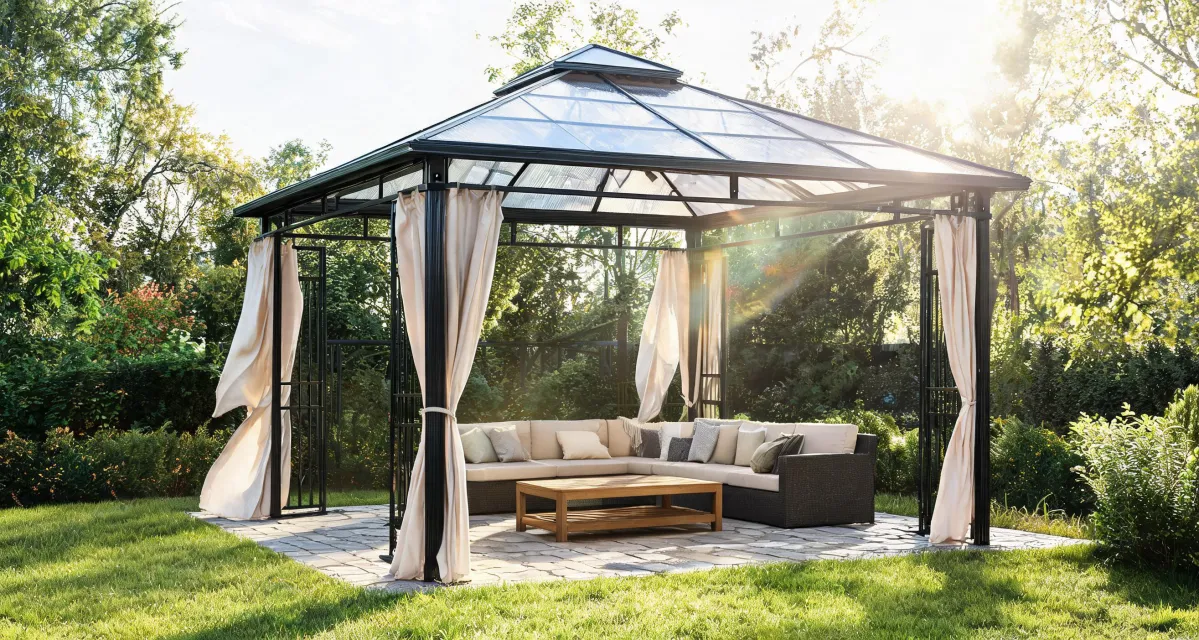
I spent last Saturday afternoon on my knees on the back deck, a tape measure in one hand and a framing square in the other, checking the corner joint of a SOJAG sun shelter against the post it slides down onto. The gap was small, a couple of millimeters, and that was the whole reason I was out there: I wanted to know whether the fine quality materials line on the SOJAG page meant the same thing on every product the company sells.
It doesn't. SOJAG has built and distributed sun shelters, solariums and outdoor furniture since 1993, and that one phrase is doing three different jobs across those lines. The heft and rigidity that let a fixed solarium sit through a snow load are the same qualities you don't want on a sun shelter you fold up every October.
What SOJAG Builds and Where Each Line Goes
SOJAG's catalog is three families, not one. The sun shelters are the open-air line: a powder-coated frame with a fabric or polycarbonate roof, sized around 10x12 and 12x12, built to sit over a patio table on a deck that takes sun all afternoon. The solariums are the walled, hardtop members of the family, a four-season room in miniature that ends up as a breakfast corner, a reading nook, or a shield over a hot tub. The outdoor furniture is the seating that fills the space the other two frame. A 10x12 shelter over a six-seat patio table is the classic setup; the solarium in that same footprint costs several times more and gets used year-round, which is the whole reason the two are built differently.
Its products move through a long list of vendors across North America as top-of-the-line, premium outdoor lifestyle items. That distribution matters when you're pricing one: the same sun shelter shows up under several seller names, and a low sticker on one site usually means old stock or a floor model rather than a different build. A 10x12 shelter a dealer sells for the price of a big-box gazebo is the same shelter I measured, just last year's canopy color.
Testing the Fine Materials Claim With a Tape Measure
Treat the company's own wording as a hypothesis worth breaking. Using only fine quality materials and innovative designs, the brand page says. If that were one uniform standard, a joint on the shelter and a joint on the solarium would measure the same. So I measured them. Same tape, same square, one afternoon: the solarium's corner joints closed to under two millimeters of gap, tight enough that you feel the frame stop rather than wobble. The sun shelter's slip joints carry four to six millimeters of play on purpose, because that play is what lets you lift the roof off and stack the rails for winter. The solarium roof panels also ran about twice the thickness of the shelter's panels, easy to feel with a knuckle.
I ran both sets of measurements again in August heat, then once more after a cold night dropped into the low forties. The aluminum moved, the shelter joints tightening a hair in the heat and opening back up in the cold, but the two lines never crossed. The claim holds. It holds per line, though, not across the whole catalog.
My SOJAG Sun Shelter vs. a Big-Box Gazebo
I kept a SOJAG sun shelter and a two-hundred-dollar big-box gazebo on the same deck for two seasons, side by side, so the weather they saw was identical. The SOJAG frame stayed squarer than the box-store frame; its diagonals were still within about a quarter inch of each other at the end of the second summer, compared with the cheaper unit, which had racked closer to an inch and started fighting its own roof panels.
The powder coat on the SOJAG rails showed no rust where the posts meet the deck, unlike the cheaper frame, whose welded feet had orange bleed by the first spring. Both tops needed re-tensioning every few months, and I'll say that plainly. The SOJAG canopy fabric faded less over the same two summers, but it did fade. Canopy weight was the other tell: the heavier top is why it fought the wind better and why putting it back on was a two-person job.
The hardware is where the difference in build showed up on a bad night. A line of storms came through, and the SOJAG's wind brace hardware and anchors held the frame through it. The box-store unit lost a leg at the joint, folded, and I spent a Saturday morning untangling it from the fence. Two seasons is not a lifetime, and I'd want another year before calling the SOJAG frame permanent.
Why Solarium Materials Would Ruin a Sun Shelter
Weigh a solarium frame and a shelter frame and the gap tells you something useful. On a solarium, weight is the product working: the extruded aluminum carries snow, the joints are meant to stay closed for years, and nobody plans to move the thing. Rigidity is the feature you pay for, and you feel it every time you close the door against a winter wind.
Put that same heavy rail on a sun shelter and it turns into a chore. You lift the roof and break the frame down at least twice a year, sometimes more if early snow catches you. A rail that takes two people to handle is a worse shelter, not a better one. The slip joints and the lighter panels that feel loose in the showroom are the premium choice for something foldable. Multiply that by a decade of seasonal takedowns and the lighter frame is simply the one you'll still be willing to move. One adjective, opposite requirements.
Which Line Actually Earns the Premium Label
Line by line, the premium wording holds up where the structure is built to stay put. The solariums and the fixed members of the family are genuinely top-of-the-line, premium, and their joints measure like it. If you're buying a solarium, you're buying the tight joints and the heavier rail on purpose. The fold-away sun shelters trade some of that rigidity for portability, and they should. The furniture sits in the middle: solid frames, cushions that keep their shape for a few seasons, nothing exotic.
The premium claim on the SOJAG page is true, then, just calibrated to what each product is for. It reads as a rating system rather than one grade stamped on the whole catalog, and once you've measured two of the lines yourself, that's exactly how it behaves.
What Would Change My Mind About SOJAG
Three things would flip me. A production run of SOJAG sun shelters measuring the same joint tolerance as its solariums would kill the per-line conclusion outright. A shelter that stayed bolted down through a full four-season cycle without its slip joints wallowing out would do the same. And a cheap gazebo whose powder coat lasted as long as SOJAG's in the same salt-and-freeze climate would make the premium frame hard to justify.
Which brings me to the question I get most: isn't the big-box gazebo just fine? If your structure goes up in May and comes down in October, yes, buy the cheap one and put the savings into the furniture, because you'll never collect on rigidity you don't need. The premium frame earns its money when the thing stays in one place all year and has to carry a snow load and a wind storm without you thinking about it. Match the build to how the structure actually lives on your deck, and the phrase on the SOJAG page stops being a slogan and becomes a decision.

Noura Khalil
Noura Khalil is an artificial greenery and home decor analyst specializing in faux flowers, plants, trees, artificial turf, wall art, vases, frames, decorative mirrors, ornaments, candle holders, and clocks. She uses ISO 4892-2 weathering and ISO 105-B02 lightfastness methods while comparing color change, gloss retention, stem recovery, pile density, seam strength, surface durability, and dimensional stability. Her work helps retailers, interior designers, and hospitality buyers choose lifelike, durable pieces for lighting conditions, traffic levels, cleaning routines, and indoor or outdoor placement.