How to Find the Right Sojag Gazebo Replacement Parts
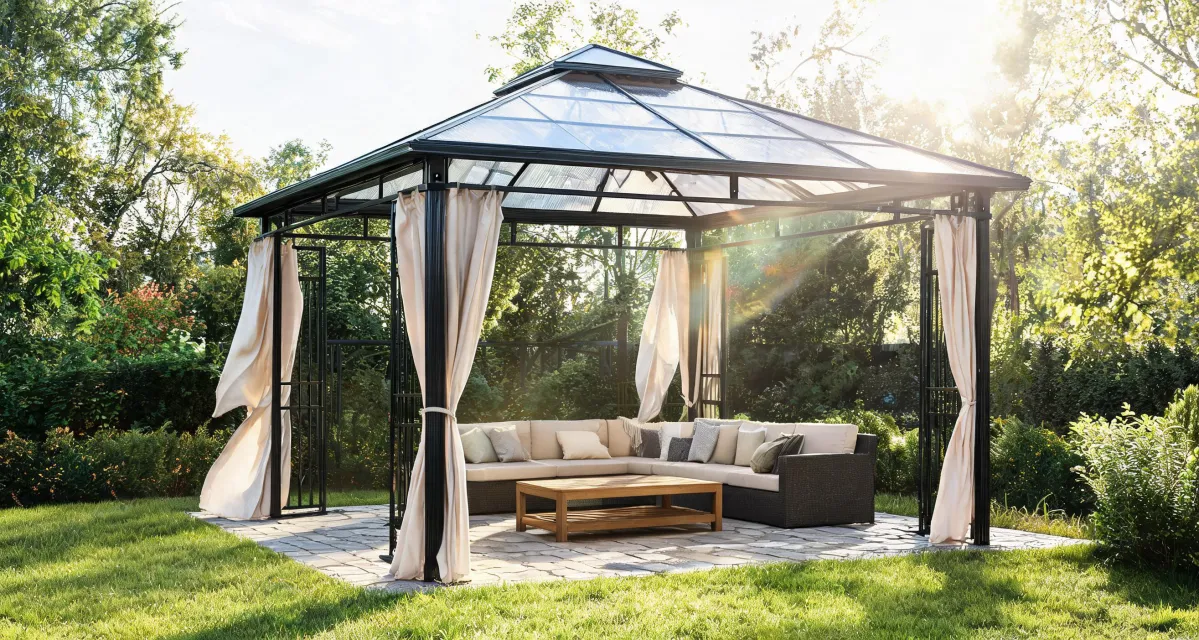
Dripping with sun tea glass in hand, you settle into the low chair under your Sojag gazebo—just in time to hear a branch claw the roof. The fabric rips along the seam, a clean six-inch tear, and the lazy afternoon snaps into a decision. The aluminum frame still squares up, the floor is level, but the canopy is unusable. That leaves one question, and it isn't how to patch it—it's where you find a Sojag replacement part that actually fits this frame without playing roulette with universal sizes.
A Saturday tear: when the gazebo canopy gives out
Your first instinct is to treat the gazebo like any rectangle you can measure: pull out the tape, note the canopy width and depth, then order a universal '10 x 12 foot' replacement that promises broad compatibility. But a Sojag structure is not a rectangle with fabric draped over it; the canopy is tensioned to a steel frame with grommets placed at specific intervals, pole pockets cut to match the slope of the roof, and tie-down straps that lock onto notches on the rafters. The damage you see after you lower the canopy confirms the difference: the six-inch tear runs beside the seam where the fabric has been rubbing the roof frame for three summers, and when you inspect the structure underneath you find no rust blooms, no bent tube, and no cracked joint. The roof frame still holds its square, the legs still sit plumb, and the level floor hasn't shifted. So the failure is entirely in the fabric layer, and the repair is a cover issue, not a frame issue. That distinction matters more than you'd think, because it determines which replacement route you need.
What you need, then, is not just a piece of shade cloth with matching width and length, but a canopy replacement engineered to attach to this frame's grommet layout, strap positions, and roof slope. So you type the obvious query into a search engine, and the results are a mixed bag: a discount tarp claims to fit 'most rectangular gazebos,' a no-name replacement canopy comes from a marketplace seller, and an ad for a different brand's patio cover interrupts your scan. None of them asks whether your model is a Sojag Boulevard or a Messina series, and none of them knows how the original canopy was attached to the frame. The natural next question is whether the manufacturer has a structured way to serve replacement parts, or whether you are expected to match dimensions and gamble on the hardware lining up. Is there an official route that reads your model name and returns the right kit—or is a tape measure the only tool you are supposed to trust?
How the official finder sorts replacement covers from frame kits
A generic search and a structured parts lookup show their difference before you even open a product page. A generic search for 'gazebo replacement canopy' gives you a stream of independent sellers, each one offering a cover that is 'close enough,' with disclaimers telling you to verify the pole distance and grommet spacing yourself. Every listing makes you the engineer, and every engineer in that position has to decide which set of measurements matters more. The manufacturer's official navigation, on the other hand, opens with a different assumption: it sorts the major ways a gazebo fails, and it labels them. You see the word 'Replacement' followed by straight nouns: Cover Finder, Floor Frame Kit Finder. Before you have clicked a single result, the page has already told you that repairing a gazebo usually means replacing either the cover or the frame kit, and that the maker has a tool for each.
When you open the Sojag site and scan the main menu, the evidence of that structured system is right there in the navigation: 'Replacement Cover Finder' and 'Floor Frame Kit Finder' sit side by side, and not far below them the menu lists 'Replacement Cover Kits,' 'Canopy Replacement Covers,' and 'Winter Gazebo Covers' among the related categories. At first glance it is just a long list of accessory labels, but once you read it as a decision tree, the meaning changes. The Cover Finder is not a catalog of every fabric rectangle the brand sells; it is a tool that translates a model number into a canopy designed for that specific shape. The frame finder does the same for the metal skeleton—useful exactly when the damage is not in the fabric but in a bent leg or corroded connector. This discovery is the turning point of the whole replacement case: instead of asking 'which size looks right?', the navigation asks 'which layer of the structure is broken?', and then offers a guided route for each answer. That one piece of context shifts the entire search from guesswork to a verified path.
But the navigation creates a decision before it solves one, and it is a decision that many gazebo owners skip: what actually failed on your structure? Fabric tears and UV breakdown usually point to the cover, while rust, bends, and shifting floors point to the frame. If you skip that judgment and go straight to a canopy measure, you can end up with a new cover stretched over a frame that is no longer safe. So ask the mechanical question first: do you see a rip in the skin, or a fault in the bones? When the frame stays straight and the floor stays level, the answer is fabric; when a corner bracket has gone orange with rust or a leg has buckled, the answer is the frame. The official tools are built to act on that answer, but they only work if you give them a truthful starting point.
Generic vs. official: comparing replacement cover paths
At this point you are weighing two paths, and they are not equal distance apart. The cheapest path is the universal canopy you can carry out of a big-box store today; it is quick, it is inexpensive, and it promises to fit with a tape measure and some patience. But a universal cover buys its simplicity by ignoring the engineered anchors of a Sojag frame: grommets on a universal edge are usually spaced for a generic pole hook, while the Sojag frame has notches positioned to match the tension of the original fabric; the universal straps, meanwhile, have to be tied somewhere on the rafters because the original anchor points are not where the generic cover expects them. You can make it fit, in the same way you can make a too-large tarp fit a car, but the fit is a compromise that shifts with every breeze. The seams of a compromised cover bear extra load at the mismatch points, and after a season of sun and wind you may be back to the same Saturday afternoon, with a new tear and an older frame. That is the real cost of choosing generic: you trade a few dollars today for a cover that may not seat into the very hardware pattern it needs to survive.
By contrast, when you keep the decision inside the manufacturer's route, the categories in the official store show why the hardware match matters. Sojag's menu distinguishes 'Replacement Cover Kits' from 'Canopy Replacement Covers' and points to a separate frame-level route close by. Reading those categories against the condition of the gazebo creates a clean rule: if the tubing is square, the floor is stable, and the damage is limited to the fabric—the scenario in the opening scene—you need the cover route, and the Cover Finder is the tool that makes size translate to fit. If you see a bent support, rusted connector, or a base that has sunk, the frame is the broken layer, and the frame finder is the route that addresses what is actually holding the cover up. The point of the official system is not to up-sell you into a frame kit you don't need; it is to make sure the layer you replace is the layer that failed. Without that distinction, a cover-only purchase on a bent frame is money spent on a symptom.
Still, the generic-versus-official decision has a second fork hidden inside it: even when you have decided that the cover is the problem, you can be tempted to trust the universal canopy that matches width and length. The question that should stop you is not about the outside footprint but about the inside geometry. Will a replacement's grommets land on the same spacing as the frame's hooks, and will its tie-downs reach the same anchor points? If those line up only 'roughly,' the cover fits when it is slack and pulls unevenly when it is tight, and the stress finds the weakest seam. So the real comparison is not official money versus generic money; it is a part engineered to the frame versus a part that asks the frame to bend to its pattern. Which one deserves your money when a storm is three days out?
Weekday support: confirming your part number before checkout
When you have narrowed the official route to a specific cover kit, a new uncertainty appears: model numbers, year-specific tweaks, and the question of whether the kit listed on the site really matches a gazebo you bought three seasons ago. That is precisely where the support promise printed in the same navigation becomes decisive. The official page states that Sojag offers '7 days a week US-based customer support,' a detail that is easy to skim but worth reading twice in a replacement-parts case. It means that after the Cover Finder suggests a part, you can call and give a real person the model printed on the frame label and the specific damage you found, and have that person confirm the match before any money moves. In the Saturday scenario, that backup turns a 'probably right' part number into a confirmed one, because the representative can check the grommet pattern and the kit contents against the frame dimensions for your model. The support line is not a generic helpline; it is the verification layer that closes the gap between a self-service lookup and a part delivered to your driveway.
Imagine how that plays out in practice on the same Saturday. You have used the Cover Finder, and it lists a canopy cover for your model, but the product page warns you to verify the model before ordering, and the part number does not look like anything you can cross-check on a third-party site. You call the 7-day support line; a representative answers, asks for the model identifier on the frame and whether the frame itself shows rust or bending, then confirms that the listed cover matches the grommet spacing and the strap positions of your frame. The representative may also flag that your model uses the updated tie-down version rather than the older hook style, which would have been a mismatch if you had relied on measurements alone. That phone call does not take half an hour; it takes minutes, and it converts the finder's suggestion into a fact.
All of this collapses into a simple verification sequence before you press order: locate the model marking on the frame or on the original parts label, state whether the canopy or the frame is the damaged layer, and read back the part number the finder gives you. If you are missing the label, be ready to describe the frame's connector pattern or measure the grommet spacing on the old canopy, because that is often enough for support to identify the model generation. Two conditions set the boundary of the rule: the verification only helps if you know which layer failed, and it only saves you if you call before checkout rather than after the return window closes. Once those are settled, the order has a number you can trust.
The canopy is whole again: returning to the same Saturday spot
A week and a half after you place the order, the box from Sojag arrives with more than a folded rectangle of fabric. Inside are the matching tie-down straps, the edge caps that anchor the canopy to the roof rails, and a cover whose grommet holes line up with the frame hooks without you having to stretch or force them. Installation becomes a sequence of satisfying clicks rather than a wrestling match: you pull the new cover over the same frame structure, seat the grommets, hook the straps at the marked anchor points, and the roof tautens across the top with even tension. When you finish, the gazebo looks the way it did the day it was assembled, and you realize the repair was not a custom fabrication or a lucky guess but a structured replacement that matched the part to the structure.
The rule you take away is simple, and you can reuse it next season without calling anyone first. When the fabric fails, go to the Cover Finder; when the frame fails, turn to the frame finder; and before you finish any order, use the seven-day US-based support line to confirm the part number against your model. The step you used to assume was impossible—finding the exact Sojag gazebo replacement part for an older structure—is actually a guided lookup, not a tape measure contest. So the next time you spot a tear, you won't measure twice and order once on a hunch; you'll sort the layer, let the official finder select the kit, and let a support representative verify the fit before you click.
You return to that same chair on the next Saturday, under a canopy that now sits square and silent, and the torn afternoon becomes a reference point: name the layer of damage, ask the official system to find the matching part, and let a short call with support confirm the order before you buy.

Ingrid Falk
Ingrid Falk is an outdoor living products analyst specializing in fences, pergolas, gazebos, canopies, greenhouses, shade sails, patio sets, outdoor sofas, and weatherproof cushions. She uses ISO 4892-2 and ASTM G154 weathering methods while comparing UV color change, coating adhesion, corrosion resistance, frame load, joint stability, water shedding, and dimensional movement. Her work helps garden retailers, project buyers, and hospitality operators select structures and furniture suited to wind exposure, climate, installation method, maintenance, and expected occupancy.