Choosing the Sojag Messina 10 x 10: A Decision Framework for Your Yard
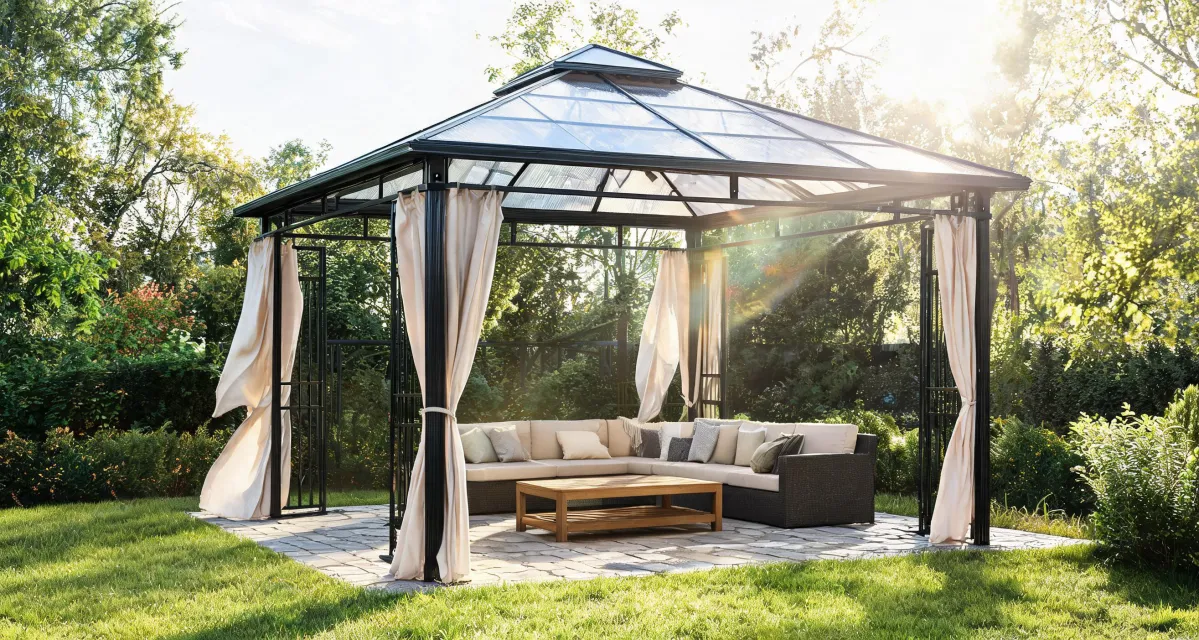
Is the Sojag Messina 10 x 10 the right answer for your backyard, or is the 10x10 footprint going to cost you more than the price tag suggests? You are standing in a patch of yard that measures roughly ten by ten, and the online cart already holds the Messina, so the real question is not whether the model is good — it is whether you are choosing the right trade-off. A smaller footprint can feel like a compromise when a dining set demands room for six chairs, yet the same footprint can feel generous when the goal is a shaded seating nook for two. Price is the loudest number on the page, but it is rarely the one that determines whether you are still happy with the purchase next summer. The decision comes down to three quieter factors: whether the 10x10 earns its corner of your yard, whether your patience for assembly matches the kit, and whether the brand behind the frame will be there when something needs an answer. That last one, after-sale support, is the factor most buyers ignore until they need it. So before you click buy, ask yourself which of those three costs you are actually willing to pay.
The 10x10 Dilemma: What Are You Really Choosing?
Is the Sojag Messina 10 x 10 the right answer for your backyard, or is the 10x10 footprint going to cost you more than the price tag suggests? You are standing in a patch of yard that measures roughly ten by ten, and the online cart already holds the Messina, so the real question is not whether the model is good — it is whether you are choosing the right trade-off. A smaller footprint can feel like a compromise when a dining set demands room for six chairs, yet the same footprint can feel generous when the goal is a shaded seating nook for two. Price is the loudest number on the page, but it is rarely the one that determines whether you are still happy with the purchase next summer. The decision comes down to three quieter factors: whether the 10x10 earns its corner of your yard, whether your patience for assembly matches the kit, and whether the brand behind the frame will be there when something needs an answer. That last one — the support after the sale — is the factor most buyers ignore until they need it. So before you click buy, ask yourself which of those three costs you are actually willing to pay.
Who actually stands behind the Messina when the box arrives with a scratched rail or a missing bolt? That question matters more than the spec sheet, and the answer starts with the name on the corporate page. Sojag operates under the ShelterLogic umbrella, the same family that builds Arrow carports and a wide range of outdoor structures, which means the Messina is not an orphan product from a brand you will never reach again. ShelterLogic Direct advertises US-based customer support available seven days a week, and that promise appears across the Sojag pages as a standing commitment rather than a footnote. The practical effect is simple: if a part arrives damaged or a step in the manual confuses you, there is a human on the line who can talk through the fix instead of leaving you to guess. That safety net does not make a poorly chosen size work — a too-tight footprint is still too tight — but it removes a whole category of risk that discount brands quietly push onto the buyer. So the brand context changes the decision by adding a backup layer, and with that in mind the next question becomes whether the 10x10 dimensions themselves match what you actually want to put underneath.
Space Check: Will the 10x10 Footprint Earn Its Corner?
Does a 10 by 10 footprint give you enough room, or does it just look like enough on the spec sheet? The answer depends entirely on what you plan to place underneath. A standard dining arrangement — a table plus four to six chairs — tends to need more open width than a 10x10 footprint comfortably allows once you add walking space around it. If people have to squeeze past the chair backs to reach their seats, every dinner outside turns into a small negotiation. A seating nook, by contrast, asks much less of the floor plan: two chairs, a small side table, and a clear path in and out can fit without touching the edges. So the same gazebo that feels cramped with a dining set feels almost roomy as a shaded lounge. The key is to measure the actual furniture you own, not the furniture in the product photo, and to leave a margin for movement rather than filling the space edge to edge. Walk the perimeter with a tape measure before you commit, and if the table leaves less than a comfortable passage, the 10x10 is the wrong call regardless of how good the frame looks.
But how do you know whether your yard gives that footprint room to breathe, rather than just room to exist? A gazebo needs more than the exact square it stands on; it needs clearance for the roofline, for wind to move around the frame, and for you to reach the posts when you tighten anchors or replace a cover. A 10x10 structure placed tight against a fence line will throw shade exactly where you want it, yet it can also trap leaves and make the back corner hard to access. A practical rule is to treat the footprint as the minimum, not the total: allow a buffer of a foot or two on the open sides so the structure reads as intentional instead of wedged in. If your patch of yard is genuinely ten by ten with no margin, the Messina will sit there and function, but every maintenance task becomes an exercise in reaching around the frame. That is not a reason to abandon the size; it is a reason to verify that the corner you have in mind is the corner you actually measure. Only when the tape measure says the space exists with room to spare does the footprint earn its place in the decision.
Assembly and Structure: What Your Weekend Really Costs
What does assembly actually cost you, once you count the hours and the patience, not just the price tag? For a structure this size, the honest answer is that setup is a project, not a quick afternoon. Two people working methodically can usually move through a frame-and-canopy build in a weekend, but that estimate assumes the ground is level, the parts are complete, and no step in the manual sends you back to the previous page. A sloped lawn turns every post into a shim-and-measure exercise; a missing bolt turns a planned morning into a customer-service call. The structural reality is that a 10x10 frame carries a large canopy, so every joint has to be snug and every anchor has to hold — which means rushing the job is the fastest way to turn a reasonable kit into a wobbly one. Think of assembly as a hidden second price: the cheaper the unit, the more of that cost tends to land on you in the form of unclear instructions, stripped hardware, or parts that need persuasion. What matters is that you honestly rate your own tolerance for that work before you choose the model, because a weekend of frustration is a real price even when the dollar amount looks right.
So what separates a manageable assembly from one that becomes a story you tell with a sigh? The dividing line is preparation, and most of it happens before the first pole comes out of the box. A level surface — concrete, pavers, or compacted gravel — removes the hardest variable; a frame that starts plumb stays square as you work upward. Having a second set of hands matters more than any tool, because holding a roof section steady while the other person drives the pin is the difference between a ten-minute step and a forty-minute struggle. The kit's own design matters too: frames with clearly labeled parts and captured hardware move faster than those where you sort twenty similar screws into a guessing game. But even a well-designed kit punishes the buyer who starts late in the day with rain on the forecast. The conditional decision is to compare your willingness to do that work against what you are saving in dollars — if the cheaper unit costs you an extra weekend of frustration, the difference is not a saving, it is a transfer. Judge the Messina by that standard, and the build stops being a spec sheet concern and becomes a personal one.
Support After the Sale: Why Backing Beats Specs
What happens after the sale, when the canopy is up and the first storm has tested the seams? That is the moment most buyers discover what they actually paid for. A gazebo is a seasonal product in the sense that it lives outside year-round, and covers, zippers, and frame joints all age in ways the showroom photo does not predict. If a seam splits or a pole bends, the buyer of a no-name unit faces the same internet search that led them to the product in the first place — only now they are hunting for a replacement part from a seller with no phone line and no clear policy. The cost of that after-sale gap is not theoretical: it is measured in a summer without shade, or in buying a whole new structure because a replacement cover was never available. Support, in other words, is not a soft extra; it is the mechanism that keeps the original purchase alive when something goes wrong. The catch is that you cannot test this dimension from the product page, so you have to judge it by the brand's demonstrated behavior — whether they publish a support promise, whether they staff it with real hours, and whether the company behind the logo has a track record you can verify.
Does the Sojag brand actually deliver on that support test, or is the support page just decoration? The evidence points to a concrete commitment rather than a slogan. As a ShelterLogic brand, the company advertises US-based customer support seven days a week across its official pages — a promise that repeats on the main storefront and on the support materials, which suggests it is not a one-off line but a standing operational policy. What that changes for a Messina buyer is the risk equation: if a part arrives damaged or a manual step is unclear, there is a real channel for a fix, staffed on weekends when most people actually do their builds. The boundary condition is that support resolves problems; it does not redesign your space. A buyer who chooses the wrong size still lives with the wrong size, and a promotional discount does not eliminate a structural defect that should be returned under warranty. So the honest reading of the evidence is that the 7-day support promise converts an unknown risk into a managed one — and that alone can justify choosing the Messina over a lower-priced competitor that leaves you to spend the season troubleshooting on your own.
A Decision Rule for the Sojag Messina 10 x 10
So how do you turn the three dimensions — space, assembly, support — into a single call instead of a pile of trade-offs? The synthesis is a conditional rule, not a universal verdict. Buy the Sojag Messina 10 x 10 if the footprint matches the way you actually use the yard: a seating nook, a reading corner, a grilling station that needs shade rather than a full dining room. Buy it if you can give the assembly a real weekend with a second pair of hands, because the frame-and-canopy build is honest work that rewards preparation. And buy it if you value the post-purchase safety net, because the ShelterLogic connection and the seven-day support promise turn a possible headache into a phone call. The rule fails only when those conditions flip: if the 10x10 squeezes the table you already own, if you have no time or help for the build, or if you are choosing the model purely on the assumption that a name brand makes every size right. In those cases no amount of support makes the structure fit, and the honest move is to measure again, budget more help, or compare against a unit whose footprint actually clears the furniture.
Where does the price fit into that rule, and when does a promotion tip the balance? The final decision rule is to let the three conditions do the heavy lifting and treat the discount as a tie-breaker, not the reason. Sojag site promotions can reach up to 60% off select structures, which means the Messina can land in a price range where the brand's support and assembly expectations come almost as a bonus. But a discount only matters if the underlying conditions already hold; a 10x10 at a great price is still a 10x10, and a frame that needs a weekend of careful work is still that same weekend. So the closing rule reads: choose the Messina when your measured space clears the footprint with room to move, when you can commit the time and help the build deserves, and when the seven-day support line makes the post-purchase risk acceptable — then let the promotional price confirm the decision rather than create it. If any of those conditions fails, walk away regardless of the percentage off, because the money you save on the purchase will be spent on the frustration later. That is the judgment this decision actually rewards: fit first, effort honestly, support as the safety net, and price last.
Where does the price fit into that rule, and when does a promotion tip the balance? The final decision rule is to let the three conditions do the heavy lifting and treat the discount as a tie-breaker, not the reason. Sojag site promotions can reach up to 60% off select structures, which means the Messina can land in a price range where the brand's support and assembly expectations come almost as a bonus. But a discount only matters if the underlying conditions already hold; a 10x10 at a great price is still a 10x10, and a frame that needs a weekend of careful work is still that same weekend. So the closing rule reads: choose the Messina when your measured space clears the footprint with room to move, when you can commit the time and help the build deserves, and when the seven-day support line makes the after-sale risk acceptable — then let the promotional price confirm the decision rather than create it. If any of those conditions fails, walk away regardless of the percentage off, because the money you save on the purchase will be spent on the frustration later. That is the judgment this decision actually rewards: fit first, effort honestly, support as the safety net, and price last.

Ingrid Falk
Ingrid Falk is an outdoor living products analyst specializing in fences, pergolas, gazebos, canopies, greenhouses, shade sails, patio sets, outdoor sofas, and weatherproof cushions. She uses ISO 4892-2 and ASTM G154 weathering methods while comparing UV color change, coating adhesion, corrosion resistance, frame load, joint stability, water shedding, and dimensional movement. Her work helps garden retailers, project buyers, and hospitality operators select structures and furniture suited to wind exposure, climate, installation method, maintenance, and expected occupancy.