How to Choose the Right Curtains for a Sojag Meridien Gazebo
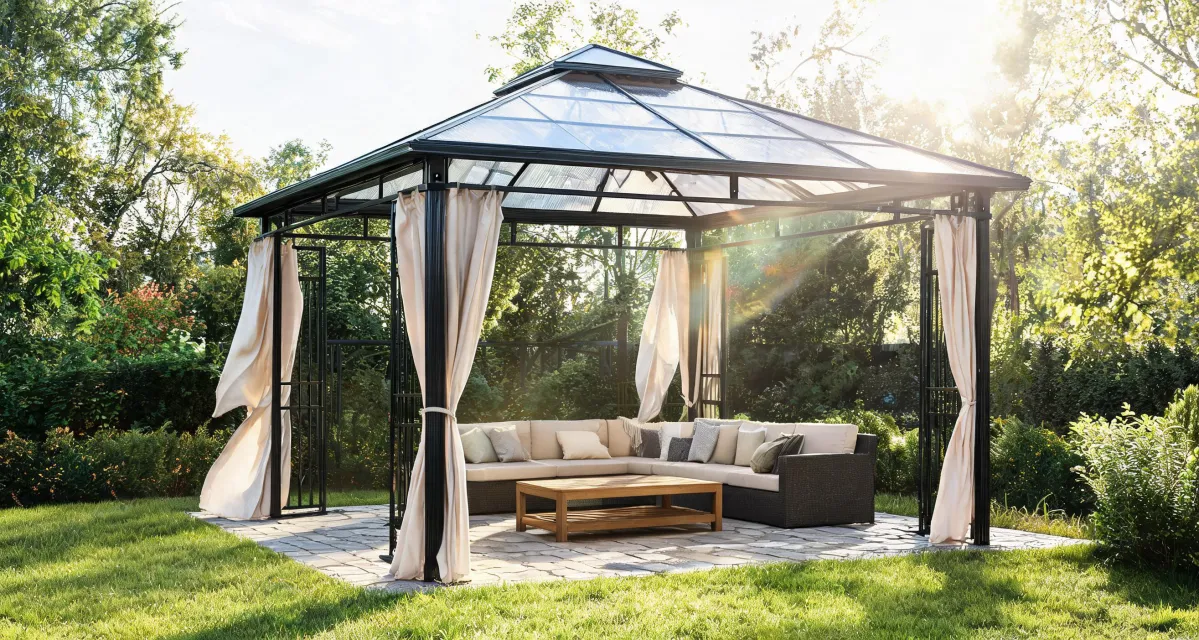
For a Sojag Meridien gazebo, the right curtains aren't the most expensive ones—they're the ones that fit your structure and your climate. Skip the generic panels and start with three decisions in order: measure the distance from the eave to the ground and between posts, choose a mounting method that lets you adjust tension, and only then pick a fabric that balances sun, privacy, and airflow. A simple rule keeps you out of trouble: leave five to ten centimeters of clearance at the bottom so water can escape and wind doesn't lift the panel.
Meridien Curtains: Start with Purpose, Then Pick the Fabric
Curtains on a Meridien do three jobs at once, and the priority changes with your climate. They extend the hours you can actually use the gazebo—morning coffee without glare, dinner without the neighbors watching, late afternoon without the sun roasting the table. They also create a windbreak and a rain shield when the weather turns. Sojag's own positioning points this way: the company describes itself as challenging you to rediscover the outdoors, and a global leader in outdoor solutions. In practice, that means the structure is meant to be used as an outdoor room, not a decorative shell. The curtain is part of that room. In a hot, humid summer, ventilation and shade outweigh waterproofing; in a rainy spring, keeping water out matters more. There is no single 'best' curtain, only a best match for where you live and how you use the space. If you rarely use the gazebo in winter, a light mesh panel will serve you better than a heavy vinyl one; if the gazebo is your only covered outdoor space in a storm-prone area, the calculus flips.
So can't you just hang any ready-made curtain and call it done? It's a reasonable thought—curtains are curtains. You see a generic outdoor curtain panel at a big-box store, it's on sale, it fits your budget, so why overthink it? The problem is that the Meridien is not a rectangular window. Its eave height is higher than most residential curtain rods, and the distance between posts is wider than a typical window opening. The roofline angles inward, and the corners have columns that get in the way of a straight panel. If you buy a one-size-fits-all panel, you'll end up with light spilling in at the top, water pooling at the bottom, or fabric flapping in the first gust. The next section shows why the structure's numbers matter more than the fabric's price tag. And once the wind catches it, the damage is not just cosmetic—it can bend a track or tear the grommets.
The Meridien's Structure Decides Every Dimension
Why does size matter so much? Because the Meridien is built to standardized dimensions, and those dimensions set the hanging height, the required width, and the way panels should be drawn back. Sojag's own support page lists 'Replacement Cover Kits' and a 'Floor Frame Kit Finder' right alongside '7 days a week US-based customer support.' That tells you the manufacturer expects you to replace covers, and covers are treated as parts with exact fits. If the company offers a kit finder, it is because a wrong size is common enough to need a tool. When you measure your Meridien, you are not being fussy—you are repeating the same step the manufacturer uses to match a replacement part. Get the eave-to-ground distance and the post spacing wrong, and you'll either have a curtain that hangs like a bed sheet or one that leaves a hand-width gap at the sides. Both outcomes defeat the purpose of the curtain. A bed-sheet drape swamps the opening; a gap-filled side lets in the sun you are trying to block.
But won't a standard six-foot panel work if I just double it? Double-checking is smart, but standard panels rarely match a Meridien. The Meridien's eaves sit higher than standard curtain rods, and its post spacing is wider than a typical window. So a 72-inch panel will either drag on the floor or leave a gap at the top. A panel that's too short lets sun and rain in; a panel that's too long traps water at the hem. And because the gazebo is exposed to wind from all sides, a panel that's not tensioned will whip around and eventually tear the grommets. Think of the structure as a frame and the curtain as a membrane—it needs to be cut to the frame, not the other way around. Even an adjustable track system needs the right dropping length, so measure before you buy. And if you are ordering online, the size chart on the product page is not a lie—it's a minimum—but it also doesn't know about your floor slope.
The consequences of a wrong size are not cosmetic. A gap at the top lets in the same UV you bought the gazebo to block; a puddle at the hem becomes a mosquito breeding spot; a panel that bellies out in a gust can pull the track hooks loose. Measure three things before you buy anything: the eave height, the distance between adjacent posts, and the distance from eave to the floor where you want the curtain to stop. For the length, subtract five to ten centimeters from the eave-to-floor distance; that clearance lets rainwater run off the hem instead of soaking into the fabric and lets air move underneath so the panel doesn't balloon. For the width, measure the post spacing and add a small overlap on each side so the panels meet without a gap. If you would rather not custom-make, look for a track system with adjustable grommets or clips—it gives you the same fit without sewing. A track also lets you slide the panels open and closed, which is harder to do with a fixed rod.
No Universal Fabric: Match Material to Your Climate and Habits
Once the size is right, the fabric becomes a tradeoff among four things: light control, privacy, weather resistance, and airflow. Mesh or screen fabric gives you the best ventilation and keeps bugs out, but it doesn't block strong sun or rain. PVC or vinyl panels seal the space completely—they keep rain and wind out, but they trap heat and humidity, turning the gazebo into a greenhouse on a summer afternoon. Polyester with a water-repellent coating sits in the middle: it sheds light rain, blocks a fair amount of UV, and still lets some air pass if the weave is open. You also have to decide between opaque and translucent. Opaque gives privacy but darkens the space; translucent keeps the light but doesn't hide much. There is no all-purpose fabric, so the choice narrows down to what bothers you most in the season you use the gazebo most. For example, if you live in a dry, sunny area, you might skip PVC entirely and go with a Sunbrella-style acrylic that resists fading and lets air through.
What happens when the whole point of the gazebo is to escape the heat? You need a fabric that lets the breeze through, and that means embracing mesh or a very open weave. The brand context supports this: the company behind Sojag describes itself as a leading provider of outdoor products and solutions, and its catalog includes high tunnel greenhouses and portable canopies—products that exist to manage airflow and temperature. They are not in the business of sealing people into boxes. So for west-facing installations or climates with long, hot summers, choose a panel with a mesh insert or a fabric rated for high air permeability. Save the solid PVC for a winter enclosure or a fully shaded spot. And remember: a curtain that blocks all wind also blocks all cooling. In the heat, you want a curtain that diffuses the sun but lets a 10 km/h breeze pass through. If you must have some rain protection, look for a hybrid—mesh on the upper half and a solid lower panel. The same logic applies to humidity: in a damp climate, a sealed PVC curtain will make the gazebo feel like a shower.
Installation is where most people break their curtains. The rules are simple: leave a gap at the bottom, tie the sides back, and never seal the panels all the way around. The existence of Replacement Cover Kits in Sojag's support section is a clue—covers and curtains are treated as consumables, so you should set them up in a way that makes swapping them easy. A curtain that is grommeted and clipped to a track is easier to replace than one that is sewn to a frame. Use tie-backs or magnetic straps on the side panels to create a channel for wind to flow through; without them, a solid curtain acts like a sail. If you do want a rainproof configuration, use a bottom bar or weighted hem to keep the panel from lifting, but still leave a small gap at the top for ventilation—otherwise condensation will form on the underside of the roof. Also, install the track slightly higher than the eave line so the curtain can hang straight down without rubbing on the roof edge.
Final Verdict: The Three-Question Decision Rule
Here is the decision rule in three steps, and it applies to any Meridien owner. First, measure the eave height, post spacing, and the distance from eave to your desired hem line; subtract 5–10 cm from the length. Second, choose a hanging system that lets you adjust tension—a track with clips, grommet panels with a rope, or a curtain rod with adjustable brackets. Third, pick the fabric based on your dominant climate: mesh for hot and humid, PVC for winter or full rain protection, and coated polyester for the middle ground. That order matters: if you pick the fabric before you measure, you will end up with beautiful panels that don't fit. And remember that Sojag's own website lists '7 days a week US-based customer support'—use that resource when you are between sizes. They can tell you the exact eave height for your model, which removes the guesswork and the biggest source of returns. If you are already measuring, you have the same information the support team uses, so you can trust your numbers.
One condition makes the whole process easier: prioritize brand-matching or clearly compatible replacements. Sojag's official pages show replacement cover kits and accessories, and the same pages run promotions like 'up to 60% off select Sojag structures' and '20% off Arrow Carports.' If you are ordering a Meridien today, check whether the curtain accessory is part of a bundle or a seasonal sale. When you do need to replace a worn panel, order from the brand or from a seller that explicitly states compatibility with Meridien model numbers. A generic curtain that claims to 'fit most gazebos' is a gamble—the eave height and post spacing may be close but not exact, and the result is the same gap-and-flap problem you were trying to avoid. Brand-compatible panels also come with the documented dimensions, so you can verify them against your own tape measure before you cut or drill. That verification step is fast, and it saves you the cost of a return shipping charge.
The right curtain is the one you can measure, hang, and replace without drama. Everything else is a compromise you don't need.

Ingrid Falk
Ingrid Falk is an outdoor living products analyst specializing in fences, pergolas, gazebos, canopies, greenhouses, shade sails, patio sets, outdoor sofas, and weatherproof cushions. She uses ISO 4892-2 and ASTM G154 weathering methods while comparing UV color change, coating adhesion, corrosion resistance, frame load, joint stability, water shedding, and dimensional movement. Her work helps garden retailers, project buyers, and hospitality operators select structures and furniture suited to wind exposure, climate, installation method, maintenance, and expected occupancy.