Sojag Messina 10 x 10 Gazebo: A Conditional Yes for the Right Backyard
-
Start by Assigning the 10 x 10 Corner a Job, Not by Picking a Silhouette
-
Sort the Yard by Three Axes, and Only Then Let Messina Enter the Candidate List
-
On Sojag's Official Pages, Service and Replacement Parts Are the Signals That Count
-
Install Is Only the Beginning—Ask Where the Gazebo Will Winter
-
Final Rule: Buy Messina 10 x 10 Only When All Three Conditions Align
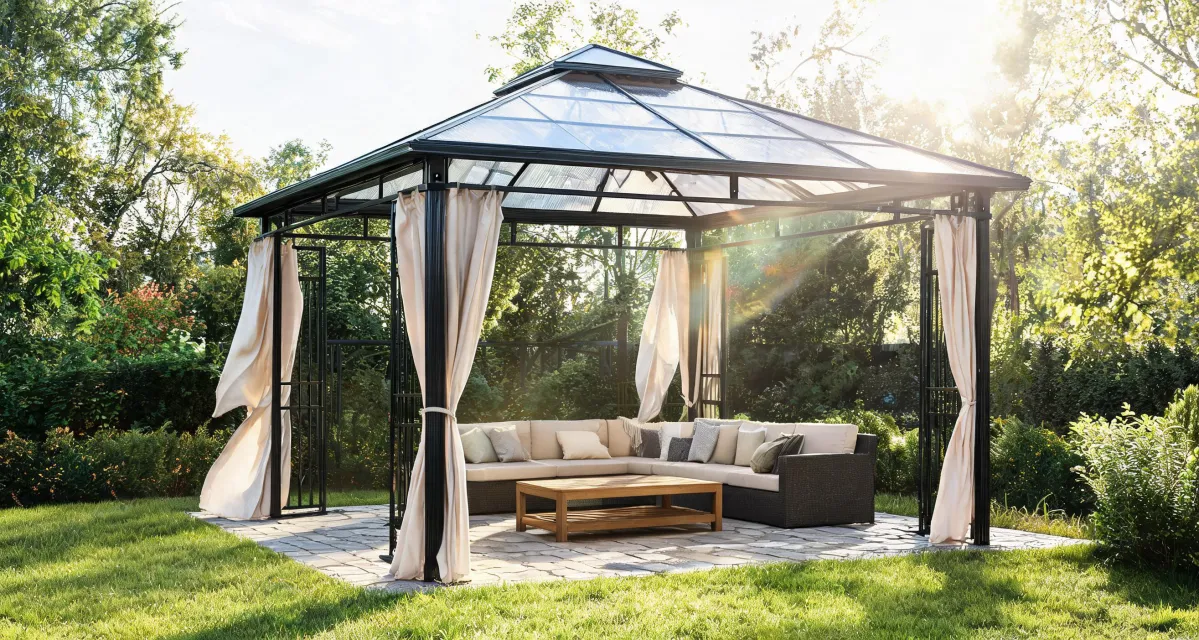
Put the same 10 x 10 corner in three different yards and you can justify three different products: a standalone Sojag Messina gazebo, a wall-mounted canopy, or a compact carport. The budgets can nearly overlap, so the photos will not settle the choice. What settles it is the job you assign the space—afternoon dinner shade, children's play coverage, or weather staging for stored gear—because that job decides whether the Sojag Messina 10 x 10 even belongs on the shortlist.
Start by Assigning the 10 x 10 Corner a Job, Not by Picking a Silhouette
Suppose the usable patch is a ten-foot deck square. You could drop a Sojag Messina 10 x 10 gazebo on it for a shaded table island. You could attach a wall-mounted canopy to the house and keep the outer edge open for a walkway. Or you could install a compact carport to guard bicycles and a grill, though meals still need an umbrella. Each is a rational buy for the same patch. When frame and footprint costs look close, you are comparing product categories, not just brands. The safest first decision is not to chase elegance; it is to name the corner's job, frequency, and weather to survive. The Messina may win that contest, but only if you hold it.
Choosing the function before the product protects you from three assumptions. First, a freestanding gazebo occupies all four sides; if the yard needs a passage, a wall-mounted form returns one side to the house. Second, an open-side canopy handles sun and light rain, not snow; for winter furniture storage it is the wrong branch despite a friendly price. Third, a ten-foot footprint varies by exposure—sunny south, windy gap, or no nearby shed—each changing installation and upkeep. So begin with the corner's use, not a banner or flattering photo. Once you know the job, the beauty of a 10 x 10 gazebo is easy to verify but no longer drives the decision alone.
Make the question useful by reducing the corner to three inputs: clearance (level ground and headroom for a four-leg structure), exposure (summer shade and passing showers vs. all-season staging), and maintenance (willingness to buy a winter cover, store the canopy, and find replacement parts). These three bound the decision. The choice is not whether Messina looks good, but whether an open-side gazebo should serve this 10 x 10 project. The next section turns those answers into usable decision axes.
Sort the Yard by Three Axes, and Only Then Let Messina Enter the Candidate List
Three axes make that fit concrete. Footprint clearance: does the 10 x 10 patch have level ground, headroom for the roof, and margin so the frame avoids fence or gutter? Exposure intensity: bright summer lunches and brief showers, or wind and snow every cold season? Lifecycle openness: after the selling season, can you find replacement fabric, a winter top, or a floor frame kit? Each axis points to a different product family. A sunny patio needing only shade and light rain suits an open-side gazebo; heavy snow with no storage shifts the choice to a wall-mounted canopy or carport before you compare springs and cloth colors.
Once those axes are clear, ask: will the corner ever hold snow, ice, or steady autumn wind? If no—only weekend meals, kids' games, and showers—an open-side gazebo remains correct. If yes—storing furniture, firewood, or shielding a grill—the word gazebo competes with a wall-mounted canopy or compact carport. Wall-mounted units add a solid side and anchor easily; carports frame stronger but read less as leisure. That distinction is invisible in photos but decides the comparison. Separating sun-and-light-rain from all-weather staging reveals the right branch.
If the corner only needs shade and light showers, a 10 x 10 open-side gazebo is enough, and the Sojag Messina competes on assembly, appearance, and price. If protection from snow or heavy storms is required, the branch changes: a wall-mounted canopy offers one anchored side and a smaller roof span; a compact carport has a more rigid frame but reads as utility. Roof reinforcement, side walls, or a different footprint might be needed. So the issue is not the size label; it is summer shade vs. year-round weather purchase. The same square footage can shift branches depending on location and storage. Until that line is drawn, visual similarity matters less than exposure.
On Sojag's Official Pages, Service and Replacement Parts Are the Signals That Count
No independent test lab hides in the Sojag menu, but catalog structure is useful. The Sojag section sits within ShelterLogic Direct's broader outdoor program, next to carports, sheds, greenhouses, and replacement accessories. That breadth signals the brand is not an orphan page; it behaves as a year-round ecosystem. That matters because the risk is not just the first-season canopy but third-season fabric, the floor kit, and support lines. Catalog depth won't tell you which frame is stiffer, but it shows whether the company treats the structure as continuing or one-time.
If you cannot test weaves, ask whether the manufacturer will support the gazebo after sale. The official navigation answers with a replacement-cover finder, a floor-frame-kit finder, and seven-day-a-week U.S. support, all in the same Sojag/ShelterLogic structure. Those clues don't measure frame thickness, but they reveal the company's plan for the second half of ownership. Listing canopy replacement fabric, winter gazebo covers, and base-frame kits prepares for owners beyond the first summer. A storefront with only the current gazebo gives no clue about next spring's part, and that silence is risk.
Those service cues turn into a verdict for owners who expect a long service life. A seven-day-a-week U.S.-based support line and a replacement-cover finder indicate the parts that wear first—the canopy and floor frame kit—remain available. Winter gazebo covers in the same menu show the maker expects off-season storage rather than disposal. That evidence conditionally favors the Sojag Messina 10 x 10 over a page with no support structure, as it reduces the future cost of renewal. It does not automatically outdo a wall-mounted canopy or compact carport, which need their own checks. But between two 10 x 10 options at similar prices, the one with a documented replacement pathway is more likely to have a usable roof in year three. The catalog thus turns the decision from which frame sounds stronger to which shelter can be repaired and renewed.
Install Is Only the Beginning—Ask Where the Gazebo Will Winter
Think of a 10 x 10 gazebo as a system: frame, roof canopy, sometimes a floor plan, and a replacement path for each wearing part. The frame needs flat ground and clearance to assemble; the canopy needs room to avoid gutters and branches; the unit needs an off-season plan. Buyers postpone these topics until after purchase, but they belong before it. A valid plan states where the unit will stand, how much opening space the frame needs, and whether anchoring will handle wind. These are not cosmetic; they can make the Sojag Messina either easy or impossible for the spot. Install clearance is therefore a decision input, equal to panel color and discount amount.
Ask directly: will the gazebo stay out year-round, and does the official storefront offer winter covers or cover finders to keep the canopy viable? The Sojag/ShelterLogic navigation groups winter gazebo covers and replacement-canopy covers with the gazebo category, showing the seller recognizes a cold-season problem and sells the fixes. Remaining questions: is the winter cover sized for the 10 x 10 peak, and will the floor-frame kit stay available? With no enclosed shed, those product lines enter the suitability check. A hard-to-find winter cover or a disappearing floor kit raises lifecycle cost even if the ticket price looked reasonable.
If the corner has no enclosed storage and you need a year-round structure, the availability of winter gazebo covers and replacement canopy kits becomes a decision condition, not an upgrade. A wall-mounted canopy can win here: one side anchors to the house and the fabric is easier to brace against wind. A compact carport can also win because its rigid roof doesn't rely on stretched fabric and can stay outside. If you can take the Messina down each November and shed-store it, the winter-cover catalog matters less and the open gazebo stays practical. Either way the off-season plan is as important as footprint and weather exposure. A structure with no answer for its inactive months is unfinished.
Final Rule: Buy Messina 10 x 10 Only When All Three Conditions Align
For the final call, use the three conditions. First, the footprint fits: level ground, headroom, and margin so the legs avoid fences and walkways. Second, the duty is shade, sun breaks, and light rain, not continuous winter staging. Third, the lifecycle chain exists: replacement canopy covers, winter gazebo covers, floor-frame kits, and a support line appear in the official program. If all three align, the Sojag Messina 10 x 10 is a coherent candidate. If any is missing, change the candidate list before comparing fabric colors. The structure must match the use pattern and replacement path, not a Pinterest board.
Decision rule: choose the Sojag Messina 10 x 10 only when the footprint has clearance, use is shade and light rain, and the official lifecycle chain—replacement covers, winter gazebo covers, floor kits, and seven-day support—is available. Then it is a defensible buy for a family patio. Otherwise, redirect to a wall-mounted canopy if one side can anchor, or to a compact carport if the space must shield vehicles and equipment. This rule works beyond Messina: state physical limits, weather exposure, then confirm replacement parts and support before looking at a discount. If a sale is large but only two conditions hold, the low price simply makes a mismatched product cheaper. The verdict stays conditional, and that is what makes it dependable.
One boundary prevents seasonality from twisting the rule: a price reduction is a timing signal, not a suitability signal. Seasonal discounts in official pages mean the seller wants to move inventory or start a season; they don't change the real footprint, snow exposure, or part availability after the sale. If the three-part test says yes, a discount can move the purchase earlier; if no, a deeper discount only makes the wrong structure cheaper. Next season the same test applies to whatever Sojag model appears. Permanent takeaway: the Sojag Messina 10 x 10 is not for every ten-foot space; it is for the space whose job, weather, and lifecycle support align with an open-side design.
Reusable closing rule: match the 10 x 10 footprint to a use that needs shade and light rain, then confirm the official replacement and winter-care chain exists; when those align, Messina earns yes. If they do not, let a wall-mounted canopy or carport take the job. Discounts change when to pay, never what to buy.

Ingrid Falk
Ingrid Falk is an outdoor living products analyst specializing in fences, pergolas, gazebos, canopies, greenhouses, shade sails, patio sets, outdoor sofas, and weatherproof cushions. She uses ISO 4892-2 and ASTM G154 weathering methods while comparing UV color change, coating adhesion, corrosion resistance, frame load, joint stability, water shedding, and dimensional movement. Her work helps garden retailers, project buyers, and hospitality operators select structures and furniture suited to wind exposure, climate, installation method, maintenance, and expected occupancy.