Sojag Monaco Champagne 12×14 Gazebo: Does It Still Meet Modern Backyard Standards?
-
Does the Monaco Champagne 12×14 Still Meet Today's Backyard Standards?
-
12×14 Size Standard Updates: Footprint, Clearance, and the Timeline
-
Material Standard Evolution: Aluminum Frames and Canopy Durability
-
Installation Base Requirements: Why You Need a Floor Frame Kit
-
Maintenance Standards: Official Support and Replacement Cover Kits
-
Seasonal Standards: Winter Covers and Wind Load Requirements
-
The Final Verdict: Is This Gazebo Right for You?
Does the Sojag Monaco Champagne 12×14 still meet today's backyard standards? Yes, with conditions. Size and materials remain competitive, but installation and seasonal protection now require stricter adherence to base kits and winter covers. Official support and replacement parts make it a viable long-term purchase.
Does the Monaco Champagne 12×14 Still Meet Today's Backyard Standards?
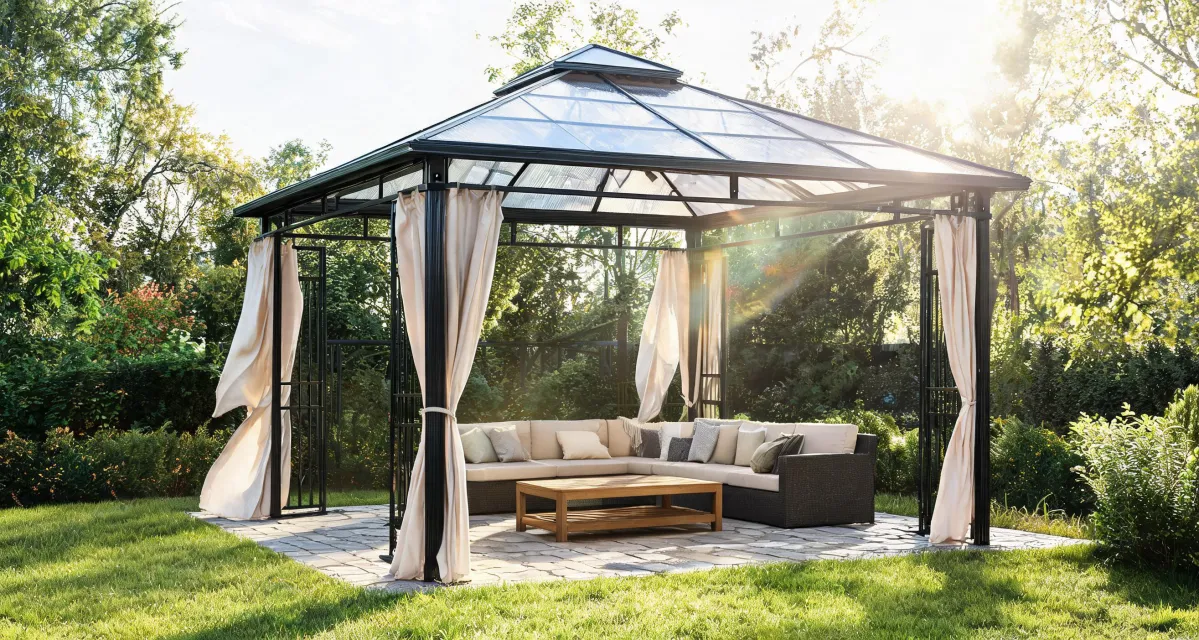
To decide if the Sojag Monaco Champagne 12×14 still meets current backyard standards, we start with the footprint. The 12×14 outer dimension gives you a nominal 168 square feet—enough for a dining set and a couple of lounge chairs without overwhelming a typical patio. However, the standards governing how you install that footprint have changed over the last ten years. In the early 2010s, it was common to stake a gazebo directly into the lawn; today, manufacturer instructions and most local guidelines require a solid, level base such as concrete, pavers, or a deck. At the same time, the industry has become more transparent about the difference between outer dimensions and actual interior space. So while the raw size is still standard, the way you are expected to use it has shifted. The gazebo itself has not fallen behind; the installation plan around it has to be updated.
A key reason the Monaco Champagne has not become obsolete is the support layer around it. Sojag's official site confirms US-based customer support is available seven days a week and sells replacement cover kits for its gazebo models, including the 12×14. That level of support matters because an outdoor structure faces constant abuse from sun, rain, and wind; eventually the canopy will fade, the stitching will weaken, or a storm will rip a panel. When you can order a factory-matched replacement cover and find the correct floor frame kit through the brand's own finder tool, you are not buying a single-use product. You are joining a maintenance ecosystem that extends the structure's life. Compare that with an unbranded gazebo where you have to guess which tarp fits and where to find parts, and the value of official support becomes obvious. This is the difference between a temporary shade and a long-term backyard investment.
12×14 Size Standard Updates: Footprint, Clearance, and the Timeline
To understand whether the 12×14 size standard has moved, think of a three-stage timeline. In the early 2010s, manufacturers often advertised a 12×14 gazebo as a direct-on-grass product, legs staked into the soil. That approach started falling out of favor around 2016–2017, as building departments and homeowner associations began requiring a solid, level surface—concrete, pavers, or a deck—for any semi-permanent structure. By 2020, the emphasis shifted to clearance: overhead height under the canopy and the gap between the structure and surrounding objects. Today, the standard assumption is that the 12×14 refers to the outer footprint, and you must plan for the actual usable interior space, smaller once you subtract frame thickness and eave overhang. This timeline shows the nominal size has not changed, but the conditions under which it is accepted have become considerably more demanding.
The practical impact is straightforward: measure before you buy, and measure again when you set up. The Monaco Champagne's 12×14 name does not tell you the clear interior area under the canopy. The frame posts and the sloped roof reduce the available headroom near the edges, and the eave overhang extends beyond the post footprint. Compare this with older marketing that often quoted the outer size as if it were the entire floor space. Under current practice, manufacturers are more transparent, but you still need to apply that knowledge. If your patio is exactly 12 by 14 feet, the gazebo will fit on paper, but the usable interior might be only 10 by 12 feet once you account for the frame. So when you plan seating or a grill, measure the actual interior width and height. This is not a flaw in the Monaco Champagne; it is the new normal for all gazebos in this category.
Material Standard Evolution: Aluminum Frames and Canopy Durability
Material standards have evolved alongside size expectations. A decade ago, many gazebo frames were heavy steel that rusted if scratched, and canopies were basic polyester that degraded within two seasons. Today's mainstream standard is an aluminum frame with a powder-coated finish, paired with a UV-stabilized fabric that resists fading and water penetration. The Sojag Monaco Champagne follows this: its aluminum frame offers a good balance of weight and strength, and the canopy is designed to shed water while holding up to sun exposure. Aluminum does not rust—a major advantage in humid climates. That said, the protective coating can still be scratched, so you need to touch up those areas periodically. And while the frame is sturdy, it is not indestructible; the strength depends on how well you anchor it to the base, which we will discuss next.
The material standard is not static; manufacturers now offer official reinforcement paths. Sojag's product ecosystem includes roof strengthening kits and floor frame kits under the same brand, which tells you that the company expects owners to upgrade the structure over time. A roof strengthening kit, for example, adds bracing that helps the frame handle heavier snow loads or sudden wind gusts—conditions that a basic 12×14 canopy might otherwise struggle with. This is a meaningful update to the old 'set it and forget it' approach. Instead of hoping the factory frame is enough, you have a documented way to bring it up to a higher performance level. The availability of these kits also suggests that the manufacturer has modeled the long-term aging of the materials and wants to keep the gazebo serviceable beyond the first season. That is exactly the kind of standard that separates a real product from a disposable one.
Installation Base Requirements: Why You Need a Floor Frame Kit
One of the most common mistakes with a 12×14 gazebo is thinking the ground is self-leveling. Sojag's own site points to a Floor Frame Kit as the recommended base, and they even provide a Finder tool to match your model. That is not a marketing gimmick; it is the current installation standard. A floor frame kit creates a rigid, continuous platform that spreads the structure's weight evenly across the ground. Without it, the legs will sink into soft soil, especially after rain, and the frame will rack out of square. The kit also gives you a solid surface to attach the legs to, which is essential for wind resistance. When you look at the official instructions, you will see that this is a required component, not an optional add-on. Skipping it voids the structural guarantee and puts the whole installation at risk.
Here's what goes wrong when you skip the floor frame. Picture a homeowner who places the gazebo directly on a lawn after a rainy week. Within a month, the soil compacted under the legs begins to shift, and one corner sinks two inches lower than the others. The frame twists, the canopy sags, and the door no longer closes properly. Even on a concrete slab, without the kit you may not have a way to bolt the legs down securely; simple stakes are not enough to hold a 12×14 structure in a high wind. The standard says you need a positive connection between the gazebo and a solid base. The Floor Frame Kit provides that connection through brackets that clamp to the legs and secure to the slab. It is an extra cost, but it is the difference between a stable shade structure and a wobbly hazard. Budget for it before you buy.
Maintenance Standards: Official Support and Replacement Cover Kits
Long-term maintenance is where most outdoor structures fail, and this is exactly where Sojag shows its strength. The brand advertises US-based customer support seven days a week, which means you can actually talk to someone when a bolt breaks or a cover gets damaged. Just as important, Sojag sells replacement cover kits that are specific to its gazebos, including the Monaco Champagne. That gives you a predictable repair path: when the canopy shows wear after a few seasons, you order the exact factory replacement instead of improvising with a generic tarp. The same ecosystem includes winter gazebo covers, so you can protect the canopy during the off-season. This kind of official support turns the gazebo from a disposable item into an asset you can maintain. For a buyer debating between Sojag and a cheaper import, the availability of genuine parts and responsive support is a decisive advantage.
Replacement policy is worth examining even during promotional events. Sojag often runs limited-time sales—at times up to 60% off selected structures—and those discounts can make the 12×14 very tempting. But the terms of the promotion do not change the product's safety or maintenance standards. What you should verify during a sale is whether the replacement parts, especially the cover kit and floor frame, are still compatible with the exact model you are buying. Manufacturers occasionally update part numbers or revise dimensions, and older inventory may not match the newest catalogs. So before you click 'buy', call the seven-day support line to confirm that a replacement cover for the Monaco Champagne 12×14 is in stock and matches your version. This step protects you from getting a great price on a structure you cannot maintain later.
Seasonal Standards: Winter Covers and Wind Load Requirements
Seasonal exposure determines how many years a gazebo will last. The Monaco Champagne 12×14 is rated for outdoor use, but that does not mean it can face an open winter without help. Sojag's official line includes winter gazebo covers, and current best practice says you should use one if your area gets snow or freezing rain. A winter cover keeps snow from piling directly on the canopy, which reduces the risk of tearing and frame strain. It also blocks UV during the months when the gazebo is not actively used, preventing fabric degradation. Some owners think they can leave the canopy up all winter; that is a mistake. Even a light snow load can add hundreds of pounds to the roof, and a gusty winter wind can stress the joints. The standard is clear: cover it or take the canopy down before the cold season.
Wind load is often underestimated by first-time gazebo owners. A 12×14 canopy presents a broad surface, and a 30 mph wind can push on it with several hundred pounds of force. The exact wind rating depends on your base and whether you add a roof strengthening kit, but most semi-permanent gazebos in this class are rated for sustained winds in the 40–50 mph range. That is not a guarantee; it is a limit. When a storm approaches, you should either take the canopy frame down if the design allows, or at least open any roof vents to reduce uplift. Anchoring the legs to a proper floor frame is only part of the equation; you also need to manage the wind load dynamically. Current standards expect owners to respect these limits rather than assume the structure will survive anything. If you live in a hurricane-prone region, a permanent pergola rated for your local wind code may be a better choice.
The Final Verdict: Is This Gazebo Right for You?
After examining size, materials, installation, maintenance, and seasonal standards, we can give a clear verdict: the Sojag Monaco Champagne 12×14 remains a worthwhile choice, but only for buyers who accept its installation and care requirements. On size and materials, it is fully competitive with anything else in its class. The aluminum frame and fabric canopy meet modern expectations, and the official support network makes long-term maintenance realistic. The boundary is the base and the seasonal routine. If you are prepared to build a proper floor frame foundation and commit to covering the unit during winter, this gazebo will serve you well for years. If you were hoping for a no-fuss product you can stake into the lawn and ignore, this is not the right pick—nor is any other semi-permanent gazebo in this category.
Here is a decision rule you can apply right now. First, measure your intended location and confirm the usable interior space is large enough; remember, the advertised 12×14 is the outer dimension, so subtract at least a foot from each side for frame overhang. Second, add the cost of a Floor Frame Kit and, if needed, a roof strengthening kit to your total budget. If that extra 20–25% expense pushes the project beyond your comfort zone, either wait for a promotion or consider a smaller model. Third, confirm that official replacement covers and the seven-day support line are available for the specific version you plan to buy. If all three conditions are met, the purchase is justified even at full price. If any one of them fails, the discount is not enough to compensate for the long-term headaches.
The Monaco Champagne 12×14 is not set-and-forget, but it is a legitimate, standards-ready structure when you respect two non-negotiables: a proper floor frame and a winter cover. Measure your space, budget for the base, confirm the replacement parts are available, and you have a gazebo that will earn its place in your yard for years. Ignore those steps, and even a 60% discount becomes an expensive mistake.

Ingrid Falk
Ingrid Falk is an outdoor living products analyst specializing in fences, pergolas, gazebos, canopies, greenhouses, shade sails, patio sets, outdoor sofas, and weatherproof cushions. She uses ISO 4892-2 and ASTM G154 weathering methods while comparing UV color change, coating adhesion, corrosion resistance, frame load, joint stability, water shedding, and dimensional movement. Her work helps garden retailers, project buyers, and hospitality operators select structures and furniture suited to wind exposure, climate, installation method, maintenance, and expected occupancy.