Sojag Meridien Gazebo Curtains: Confirm the Mounting System First
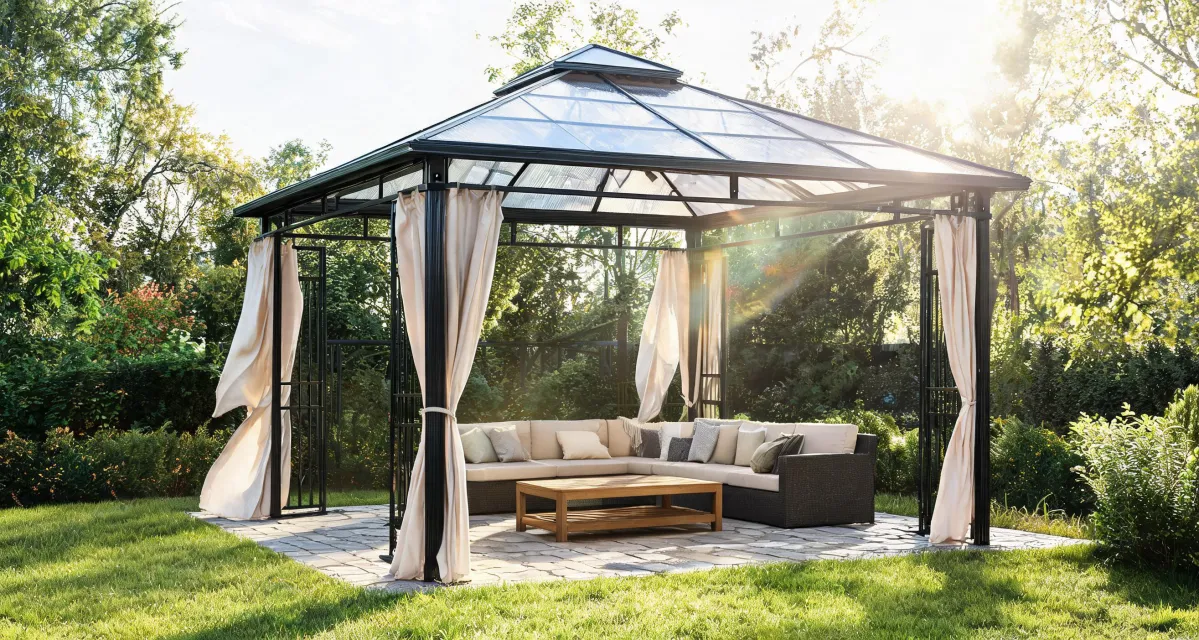
For Sojag Meridien gazebo curtains, the decision starts with the mounting system, not with color or fabric. A freestanding Meridien needs a different hanging layout from a wall-mounted one, and the frame's rails or attachment points determine which panels will sit straight and stay secure. Confirm whether your unit is attached to the house, identify the matching official accessory category, and get a part number from the brand's own parts route before you order fabric by eye.
Confirm the Mounting System Before You Pick Meridien Curtains
The mounting system determines fit in a way that fabric color never will, because a gazebo frame distributes force at fixed points rather than along a continuous curtain rod. If the top rail is a channel or track, a clip-on curtain has nowhere to bite; if the frame relies on grommet points, a curtain with a continuous pole pocket will not line up. The same Meridien model can be sold as a freestanding unit or mounted to a wall depending on how you install it, and that choice changes whether the load falls on vertical posts alone or is shared with the house structure. Curtains attached to the wrong points can droop between supports, and in a gust the fabric can pull on the roof seam. That is why the first measurement is not the diagonal of the floor; it is the rail spacing, the track type, and the distance from the top beam to the ground at each possible hanging point. Once you record those, you have a specification that any compatible curtain must match. This step also tells you whether the panels should hang inside or outside the posts, which changes both the look and the way wind pushes against the fabric.
Now ask yourself the question most Meridien owners skip: is the gazebo standing alone or fixed to the house? This is not a setup detail; it is the category key. Sojag's support page arranges the outdoor line into Wall-Mounted Gazebos, Winter Gazebo Covers, and Replacement Cover Kits, and those group labels appear next to the floor and frame kit finders rather than under a generic 'curtains' tab. The arrangement signals that the manufacturer expects you to know your frame's anchor condition before choosing a canopy or curtain panel. A wall-mounted unit can have wall flanges and a roofline that a freestanding cover cannot seal; a freestanding unit may need a longer drop to avoid a daylight gap under the panels. Answer the wall-or-freestanding question first, then use Sojag's accessory categories with that answer in hand. That answer keeps every later search inside the correct bin.
Match Your Meridien to Sojag's Official Accessory Categories
On Sojag's site, look for the labels that appear under the navigation: Wall-Mounted Gazebos, Winter Gazebo Covers, Canopy Replacement Covers, and Replacement Cover Kits. These are not broad decor departments; they are compatibility bins. Meridien products will fall into one of those bins depending on roof shape, frame anchor, and season rating. When you browse with this taxonomy, you stop typing 'Meridien curtains' and instead ask which bin your structure belongs to. The official source consistently puts Replacement Cover Kits first and separates floor/base kits from wall-mounted gazebos, which means you should treat a canopy replacement for a wall unit and a winter cover for a freestanding unit as two different product families. Read the row of service tools on that same page—Replacement Cover Finder and Floor Frame Kit Finder—as reminders that Sojag's SKUs are tied to frame generations, not just dimensions.
Compare two shoppers to make the mechanism visible. One has a Meridien bolted to a brick wall in a narrow side yard; another has the same model name on a freestanding island on an open lawn. Shoppers often assume the model name is enough, but the official catalog includes Roof Strengthening Kits, wall-mounted gazebos, and floor/base kits as separate entries, and its home page advertises structures with discounts like Gazebos, Solariums and Carports up to 60% off. Those promotions reinforce that the product families are built around a frame platform, and after the sale the platform—not the fabric pattern—is what determines which later additions fit. The wall-mounted unit may have ceiling tracks or wall flanges that a generic curtain panel cannot grab; the freestanding unit may have a lower roofline in wind. Therefore, the winning move is to write down the structural clues—anchored or not, roof angle, post spacing—and carry those clues into the accessory category, not just the width measurement. That is the process that prevents a costly return.
When you open the category list and do not immediately see Meridien curtains, ask a sharper version of the question: does the page call the product a 'canopy replacement cover,' a 'winter cover,' or a 'wall-mounted gazebo accessory'? That wording tells you which hardware family accepts a curtain. On the same support interface, Sojag lets users navigate via autocomplete and touch-friendly menus rather than forcing everyone through one universal size chart. That is a small clue: with this brand, compatibility is selection-driven, not measurement-driven. If your model name does not turn up, the next action is not to widen the search; it is to reduce the search by frame type. A wall-mounted Meridien variant belongs with wall-mounted gazebo accessories; a freestanding one belongs with replacement cover kits. Asking the question in those terms gets you to an answer without ever guessing. First identify the bin, then identify the product.
Use Sojag's 7-Day Support Line for a Definitive Fit Answer
The fastest way to settle compatibility is also the least used: call the support line. On Sojag's official product page, the phrase '7 days a week US-based customer support' sits beside the replacement-cover and floor-frame finders, not buried in a contact page. That placement tells you fit questions are routine and the company has built its accessory inventory around them. A short call or chat takes you from 'I hope these curtains fit' to 'I know what Sojag lists for my Meridien frame.' Ask whether a matching curtain kit exists or an approved canopy replacement with curtain attachments is current, and give the representative the model number printed on the frame, whether the gazebo is wall-mounted, and the spacing between posts at the top. If there is no dedicated Meridien curtain, that answer still helps: you are now in the custom-fit zone, not the clip-on zone. Use the call to confirm the exact SKU, even if the website seems to show only covers.
Before contacting support, ask yourself which piece of information you are missing, because your question changes the answer. If you do not know whether the mounting is wall-mounted, you are not ready for a product question yet; you need a structural identification question instead. Sojag's About page and the companywide support menu both repeat the same finder-and-category structure, which is evidence that this identification process is centralized rather than split among retailers. That means when you call, the person on the line has access to the same current bin system that the website uses, so the fastest way to get a good answer is to mirror their vocabulary. Say the model number, then state the two variables plainly: 'Meridien, freestanding, looking for a curtain kit' works better than a long description. Also mention whether the roof slopes toward the wall or away from it, because that changes the bracket height and lets the representative check Wall-Mounted Gazebos and Replacement Cover Kits without guessing. Write down the answer and verify it against the website category before you finalize an order.
Understanding the mechanism behind their answer matters even more than the answer itself. When Sojag separates Roof Strengthening Kits, Floor Frame and Base Kits, and Canopy Replacement Covers from each other, it acknowledges that outdoor fabrics fail by wind load, not by color fading alone. A curtain that is too long or too flat can trap air and turn the whole gazebo into a sail; that is why the official catalog lists structural kits alongside fabric replacements. The condition under which an aftermarket curtain is acceptable is narrow: it must attach only to points strong enough for lateral force, must not cover roof vents, and must be removed in high winds. If the product page mentions a roof-strengthening or frame-strengthening kit for your model, treat that as a warning that the frame alone is not designed to take an extra fabric load.
Adopt the Part-Number Rule Before You Compare Curtain Fabrics
The reusable rule is: find the official part number before you guess a size. Sojag's site maps your structure to a specific kit through the Replacement Cover Finder and Floor Frame Kit Finder, and the same menu lists Wall-Mounted Gazebos and Winter Gazebo Covers as separate product families. So when you are tempted by a generic curtain with the width matching your ground footprint, stop and check whether the top hanging method is equivalent. The deciding test is the track or rail type, not the diagonal or floor dimensions. A panel that attaches to the top beam with grommets is a different product from one that slides into a channel, and a wall-mounted frame may not have an open top beam at all. If you cannot find a Sojag SKU for a Meridien curtain, you still have a decision rule: buy a canopy or accessory kit that Sojag lists as compatible with your frame, or ask the support team for the exact hanging accessory name, then buy fabric that is built for that accessory. In that case, avoid rail adapters that are not part of the listed system, because they move the weak point from the fabric to the frame. A curtain that is compatible by part number is a purchase; a curtain that is compatible by tape measure alone is a gamble.
Keep the rule conditional so it survives different houses and seasons. If your Meridien is in an open, windy yard and you choose a universal curtain, the conditions become stricter: limit the panel length to the frame's own hanging points, avoid installing it when storms are forecast, and inspect the mounting brackets before every season. If your Meridien is against a wall, the condition reverses—lateral wind matters less, but the curtain must clear the house siding and the fixed flange. No single curtain solves both layouts, which is why every before-purchase decision should start with the same three-part check: note the frame type, confirm the official replacement-cover category, and write down the part number that Sojag's catalog connects to your model. If your model has official winter or replacement cover versions, compare those product descriptions too; the curtain you add should respect the same sealing line that the cover uses. When those conditions are checked, the remaining choices—thickness, water resistance, color—are aesthetic and can be changed later without re-engineering the frame. That is the operational meaning of the part-number rule: hardware first, style second.
If the panel, the track, and the part number are not all from the same product family, you have not found the right curtain yet.

Ingrid Falk
Ingrid Falk is an outdoor living products analyst specializing in fences, pergolas, gazebos, canopies, greenhouses, shade sails, patio sets, outdoor sofas, and weatherproof cushions. She uses ISO 4892-2 and ASTM G154 weathering methods while comparing UV color change, coating adhesion, corrosion resistance, frame load, joint stability, water shedding, and dimensional movement. Her work helps garden retailers, project buyers, and hospitality operators select structures and furniture suited to wind exposure, climate, installation method, maintenance, and expected occupancy.