Sojag Messina 10x10 Gazebo: The Footprint Question Is Only Half the Decision
-
The real 10x10 question: footprint, or the ecosystem behind it?
-
What Sojag's catalog tells you before you settle on a model
-
Anchoring and replacement parts matter more than a 10x10 match
-
When the Messina 10x10 wins—and when wall-mounted or carport shade is smarter
-
The final rule: choose 10x10 only if footprint and support both fit
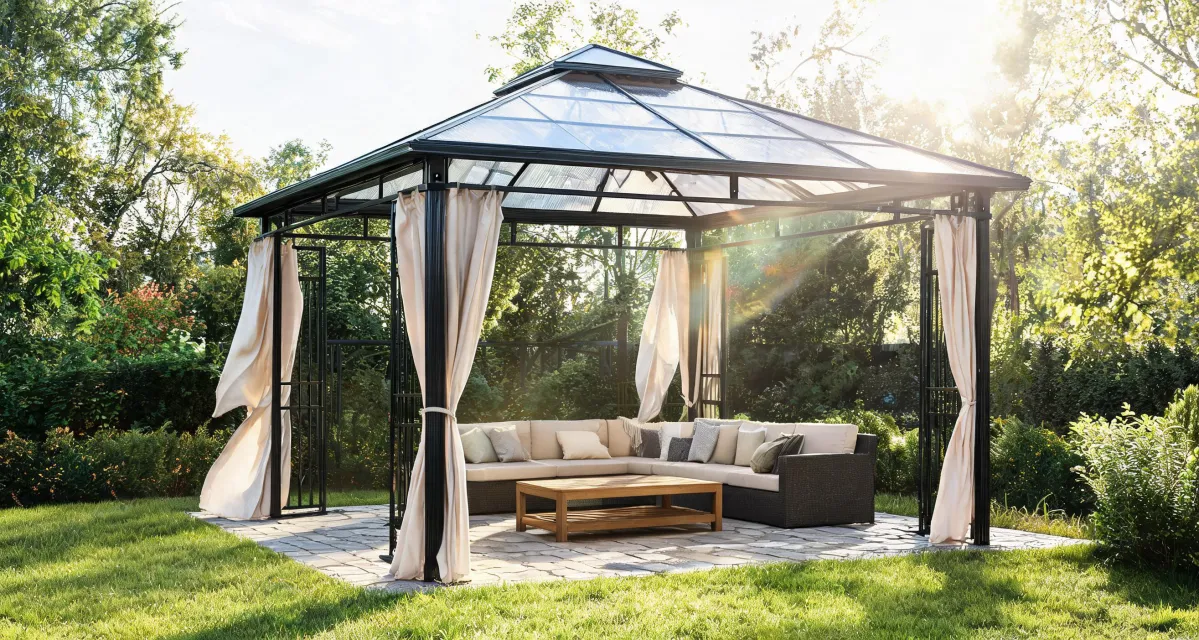
Your patio is a perfect 10x10 square, and the Sojag Messina seems designed for it, but that exact match can trap you. The footprint is a fact you can measure, while the far more important question is whether a free-standing frame will still be the right structure for that square in three or four years. You might be buying a permanent outdoor room, a seasonal event shelter, or a low-cost party tent, and each of those uses carries different requirements for anchoring, maintenance, and support. The Messina can be a sensible buy in the first case and a waste of money in the third. So before you let 10x10 decide, separate the size question from the brand-and-support question; the answer only makes sense when both are lit up.
The real 10x10 question: footprint, or the ecosystem behind it?
All 10x10 frames appear to be equivalent because they occupy the same ground, but the product catalogs behind them could not be more different. A no-name kit may look identical to the Messina in a spec chart, so the burden is on you to ask what the extra money buys. The common answer is 'the logo,' and for one-season buyers that criticism is fair. For anyone who plans to keep the shelter for five seasons, though, the real difference is serviceable parts: the frame that outlives its original roof can only be repaired if its manufacturer still sells the roof. When the maker's business model ends at checkout, any eventual failure turns the whole gazebo into waste. That single distinction will determine whether the same 10x10 footprint gives you a summer's shade or a decade of use.
The stakes become clear the moment you read the manufacturer's own corporate page. Sojag presents its parent ShelterLogic as a global leader and innovator of outdoor products—an identity backed by a visible support apparatus: a replacement-cover finder, a floor/frame kit finder, and customer support available seven days a week from the US. That apparatus exists to serve products after they leave the warehouse, which matters because a gazebo rarely fails all at once. A torn roof, bent leg, or lost part can end its life unless someone still supplies that component. In that light, the price difference between the Messina and an unnamed 10x10 starts to resemble the cost of future repairs, prepaid today. The condition is your own horizon: if the structure is meant to last, the support network is a real asset; if you intend only seasonal use, the same network is a luxury you may never use.
What Sojag's catalog tells you before you settle on a model
Before you settle on any 10x10, look at the catalog you are buying from. Sojag's online storefront does not present itself as a single-model shop. The same pages that sell gazebos also promote solariums, carports, wall-mounted gazebos, winter covers, and replacement accessories, and they advertise limited-time savings of up to sixty percent off select Sojag structures. That breadth is evidence about the maker, not just inventory. A brand that supports many structure classes is more likely to keep parts and manuals for each of them, and a customer who buys a 10x10 today is a candidate for a wall mount or carport tomorrow. The practical question is what kind of relationship you want with the seller: a one-time transaction or an ongoing product system. If the seller only exists as a third-party listing with no wider family, the odds that replacement parts remain available after three years drop sharply. For a permanent patio, the ongoing system is worth noticeably more.
The value of that system is conditional on how long you will own the structure. ShelterLogic's own about page repeats the global-leader claim, and its menu places replacement-cover kits, roof-strengthening kits, and winter covers beside the gazebo products. That continuity suggests that a 10x10 frame is designed to be repaired rather than thrown away when a roof ages. If you keep the Messina for many seasons, the catalog adjacency becomes a practical hedge: when a part fails, you are not hunting through aftermarkets. But the argument weakens with a short horizon. If you expect to move soon or want shade for one rental summer, the same ecosystem is an unused benefit, and a cheaper generic kit may serve the same purpose. The condition, in short: you get the full value only when slow ownership lets a spare part—not a new structure—extend the life of the existing frame. Sojag's own about-page infrastructure, with floor-frame kit finders and seven-day-a-week support, reinforces that the repair offer is not buried in a manual. Weigh that before choosing the Messina: the price premium is only justifiable if the after-sale continuity will still be there when you need it.
Anchoring and replacement parts matter more than a 10x10 match
Ignore the fabric for a moment and think about how the frame meets the ground. A 10x10 canopy is a broad surface that catches wind like a sail; if the legs are standing on a concrete slab with no tie-downs, the unit is only a gust away from skidding. Your site determines whether the Messina can be secured. Concrete pads need surface bolts or heavy ballast; decks need structural screws into joists; soil needs stakes that actually reach firm depth. None of that is included in the size label. Before comparing the Sojag Messina with any other 10x10, locate four anchor points in your patio and make a realistic estimate of the force they will need to resist. If the frame cannot be anchored, the footprint match is meaningless.
The second condition is the availability of replacement parts. Sojag's own website treats gazebos as part of a serviceable family: its navigation includes replacement cover kits, canopy and gazebo covers, winter covers, and roof-strengthening kits. That catalog structure is evidence that the original fabric is not a one-time component; the company sells the consumable parts separately. If your Messina roof is damaged by a branch or hail, the search for a new cover starts with the same maker, which sharply reduces the cost and uncertainty of repair. The condition that makes this decisive is damage, not slow wear: a single incident can total an unprotected frame. When the listed replacement path exists, the 10x10 ceases to be a single-use object and becomes maintainable. When no such path exists, the repair decision quickly becomes a replacement decision, and the initial savings on a generic frame may evaporate.
If both conditions are satisfied, the evidence points toward buying the Messina. Sojag's public material combines replacement-cover finders, floor/frame kit finders, and seven-day-a-week, US-based customer support—tools that make future repairs easier. These signals support a decision to pay more for a 10x10 because you are paying for access to components and advice, not only for aluminum tubing. But the same evidence has a limit: no support line can anchor a frame that is installed on an unsuitable surface. If the base is too weak or the anchors are missing, the most responsive customer service will not help on the night a storm hits. Therefore the decision rule is hierarchical: anchoring first, after-sale support second. For the suburban owner with a solid slab who wants a trouble-free decade, the combination is worth a clear premium.
When the Messina 10x10 wins—and when wall-mounted or carport shade is smarter
The next question is whether a free-standing 10x10 should be the structure class at all. Sojag's own catalog offers alternatives: wall-mounted gazebos, carports including the Sojag Samara, and enclosure kits, often promoted alongside a 20% discount on Arrow Carports or up to 60% off select Sojag structures. Manufacturers list alternatives because the right solution depends on your architecture and use. If your seating area sits against a house wall that can take mounting brackets, a wall-mounted gazebo may deliver the same shade without a forest of legs on your concrete. If the real goal is to protect a car or work area, a carport with a stronger roof may be a better fit. The 10x10 Messina is one path among these alternatives, not the only way to shade a patio.
If you compare structure classes, the deciding condition is where the load goes. Sojag's official catalog navigation places wall-mounted gazebos and carport lines next to free-standing gazebos and enclosures, and the site includes floor/frame/base kits for those lines—evidence that the manufacturer expects owners to think about attachment points and frames, not just floor plans. A wall-mounted unit transfers its weight to an existing wall, which often means less unsupported span and fewer ground-level anchor points. A carport-style shelter uses a sturdier roof profile that handles snow and wind differently from a fabric canopy. When your patio is an open island, the free-standing 10x10 becomes more reasonable because there is no wall to borrow. When a wall or vehicle is in play, the same square footage is usually better served by those alternative classes. The mistake would be choosing the Messina only because the dimensions sound ideal, while ignoring that the wall may already be the best structural support you own.
The final rule: choose 10x10 only if footprint and support both fit
After handling footprint and anchoring, the remaining question is after-sales infrastructure. Sojag's about pages list a replacement-cover finder, a floor/frame kit finder, and seven-day-a-week US-based support, which is an unusually concrete set of service claims. Why does this matter for a 10x10? Because the consumable parts—cover, straps, roof panel—typically wear out faster than the frame. If a replacement can be located and ordered by model, the user can restore the gazebo for the cost of a part; if not, the entire structure may have to be replaced. This support apparatus is valuable only when you expect to need it: a buyer who treats the Messina as a disposable canopy for one event will be paying for service that never gets used. The support test therefore separates permanent owners from seasonal users.
The credibility of that support claim grows with repetition. The phrase '7 days a week, US-based customer support' appears more than once across Sojag's public pages, usually near the same tools—replacement-cover finder, floor/frame kit finder. Repetition alone would be marketing, but together with concrete finder tools it signals a process: you identify your part, call a human, and order a replacement that matches the original model. That process matters because outdoor structures face UV, wind, and moisture that shorten the life of every component. If the official support path exists, maintenance becomes a low-friction errand. The caveat is that it benefits only the owner who will actually make the call. For a temporary setup, the same feature has zero value, and the saved money from a generic frame may be the wiser choice.
Keep this decision rule in mind. Buy the Sojag Messina 10x10 when your patio is a genuinely anchorable 10x10, your ownership horizon is long enough to need replacement parts, and you want a manufacturer with replacement-cover finders and seven-day-a-week US-based support. If any one of those conditions fails, look again at Sojag's wall-mounted gazebos or carport-style structures; those alternatives use the same brand's support system but align better with a wall, a vehicle, or a seasonal need. The footprint is the first filter, not the final verdict. Use the filter to narrow candidates, then decide on anchoring and after-sale service. Only when those two dimensions check out does the name on the frame become worth the premium.
When the wind pulls at your first summer canopy, the frame's ground connection and the phone number behind the parts line will tell you whether you chose the size or the system. Choose the system, and the 10x10 Messina can earn its place. Choose only the dimensions, and any brand will let you down.

Ingrid Falk
Ingrid Falk is an outdoor living products analyst specializing in fences, pergolas, gazebos, canopies, greenhouses, shade sails, patio sets, outdoor sofas, and weatherproof cushions. She uses ISO 4892-2 and ASTM G154 weathering methods while comparing UV color change, coating adhesion, corrosion resistance, frame load, joint stability, water shedding, and dimensional movement. Her work helps garden retailers, project buyers, and hospitality operators select structures and furniture suited to wind exposure, climate, installation method, maintenance, and expected occupancy.