Sojag Meridien Gazebo Curtains: Match the Frame First, Then Buy
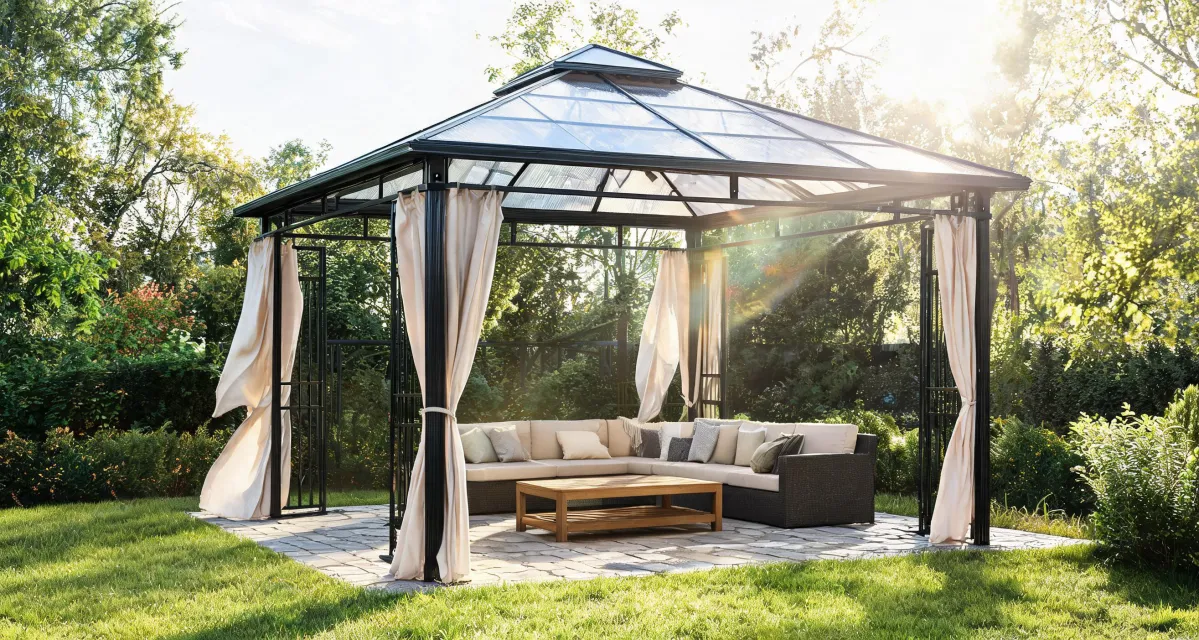
To get curtains that actually fit your Sojag Meridien gazebo, start with the frame's mounting dimensions and use Sojag's support resources—not generic drapery picked by eye. Generic panels are cheaper and available instantly, but the Meridien's track and hook spacing can reject off-the-shelf designs, causing sagging, flapping, and wear. Match the mounting interface first, and you'll avoid a second purchase and a weekend of frustration.
Meridien Curtains Are Part of Sojag's Accessory System
Sojag's site lists replacement cover kits, canopy replacements, winter gazebo covers, and wall-mounted models in the same catalog—so is the Meridien curtain a factory-backed component or an afterthought? The brand's own menu names those categories explicitly and pairs them with a support line that answers seven days a week from the U.S. That catalog alone signals the company treats curtains and covers as first-class parts, not generic add-ons. Before you measure anything, know that the manufacturer already thinks of this as a supported accessory, which changes how you shop for it. You're not looking for a generic drape; you're looking for a part that belongs to a system, and that system has built-in finders for replacement covers and floor-frame kits. Those tools exist because Sojag knows owners struggle to match the right cover to the right frame, so the matching process is now part of the site's navigation.
Picture this: you've just finished assembling the Meridien, and you're standing inside looking at the wide opening. You measure the gap between the posts—roughly six to eight feet—and then you start browsing curtain sets online. The product photos look fine, but you have no idea whether the hooks will match the rail or whether the panels will hang straight in a breeze. You're tempted to buy a cheap set that says 'gazebo curtains' and hope it works. That scene is exactly where the fit problem begins, because the frame isn't just a rectangular hole; it has a top rail with formed corners, side channels, and a specific clip spacing that off-the-shelf drapes rarely match. So before you order anything, treat the setup as a measurement problem, not a style problem. A few inches of mismatch may look like nothing in the package photo, but once the panel is up, the sagging is obvious and the wind flap gets worse.
Sojag's accessory menu goes further: it includes winter gazebo covers and canopy replacement covers, and the site promotes select structures with discounts up to 60% off. If the brand invests in model-specific covers for weather protection, why would curtains for the Meridien be a one-size-fits-all item? The catalog structure argues for a dedicated fit—otherwise the replacement-cover section wouldn't exist. That question changes the default from 'any curtain will do' to 'which Meridien-specific panel matches my frame?' Once you accept that the frame dictates the fit, the search becomes narrower and the chance of wasting money drops dramatically. Sojag also sells wall-mounted gazebos and winter covers, each with its own mounting logic, which reinforces that every accessory is model-specific. Think about that before you measure. The presence of these categories means the Meridien curtain is expected to match the frame, not fight it.
Measure the Frame First
A gazebo frame isn't just a set of poles; the Meridien's top rail and side channels create a defined hanging path. Sojag's own product pages offer finders for replacement covers and floor-frame kits—tools that exist because the geometry varies between models. That's why generic drapes fail: they assume a straight rod and uniform spacing, while the Meridien's track may have formed corners or clip slots that accept only panels with matching hooks or channels. When you buy a panel that ignores those slots, it either sags in the middle or flaps in the first breeze. The same support menu repeats across the site—replacement cover kits, canopy replacement covers, and winter gazebo covers share one catalog—so the matching problem is baked into the product line. You're not fighting a single oddity; you're dealing with a system that expects each cover or curtain to be tied to a specific frame.
What exactly should you measure? Start with the width between the outer posts at rail height—not the base, because the frame may taper. Then measure the height from the bottom of the rail to the floor. After that, look at the mounting interface: fixed hooks, a continuous channel, or a series of clips. Write down the spacing between those hooks or clips in inches, because that number determines whether a panel's grommets will line up. If you skip this step, you're guessing, and a guess can turn a 15-minute install into a weekend of returns. None of this requires special tools—a tape measure and a notepad are enough, but you need to record the numbers before you open a shopping tab. The rail is the part that actually holds the curtain, so a measurement from the floor or base can be off by several inches on a frame that tapers upward. Most gazebo frames are not perfectly rectangular; the top rail often meets the corners at an angle, changing how a curtain hook travels.
The mounting interface is not about fabric thickness; it's about how the curtain attaches to the frame. Sojag's source pages repeatedly point to finders for replacement covers and floor frames, which tells you the company knows owners struggle with compatibility. A panel that clicks into a channel stays taut because the hardware distributes wind loads along the rail; a panel hung from loose hooks will billow and stress the grommets until they tear. The same catalog lists replacement cover kits and winter covers because they all depend on the frame's specific geometry. When a curtain is designed for the Meridien, its top edge follows the rail's curve, and hooks or slides are spaced to match the existing slots. Off-the-shelf curtains skip that step, so they fight the frame instead of riding it. The consequence is uneven wear and a curtain that never hangs as intended.
Measure, Match, Then Compare Prices
The most reliable order is to measure first, then use Sojag's support tools to confirm the match. The brand's site lists finders for replacement covers and floor frames, and it advertises US-based support available seven days a week. Call or use the finder with your frame's dimensions; the goal is to identify the exact accessory line for the Meridien before you commit to any panel. That single step converts a guess into a spec. The support page embeds the finder tools in the main navigation, so you can check compatibility without leaving the catalog. When you talk to support, have your model number and the measurements you recorded. They can confirm whether the Meridien takes a specific curtain kit or whether a universal panel with the right hook spacing exists. That confirm step catches silent mismatches—like a rail that looks round but is actually oval, or hooks spaced 12 inches apart instead of the typical 16. Using the brand's own tooling flips the research burden from guesswork to specification. That makes the whole process faster and less frustrating.
Once you have the dimensions, how do you weigh original Sojag curtains against a generic set that's half the price? The real comparison isn't material weight; it's whether the generic panel has the same hook spacing and rail profile. You can sometimes find third-party panels that match, but the risk is a mismatch in the clip shape or the distance between grommets. A 3-inch difference in spacing will leave the curtain sagging or force you to improvise fasteners that damage the frame. So the question becomes: are you saving money or just deferring the cost? A cheap panel might look fine in the package, but if it doesn't lock into the Meridien's channel, you'll be buying again—or patching it with zip ties. Wind is the real test: a panel that doesn't follow the rail catches air like a sail, pulling at the grommets and eventually tearing the top hem. That's a geometry issue that no amount of reinforcement can fix. Don't forget installation time: a generic panel that needs extra clips will eat the savings quickly. You might spend an afternoon engineering a workaround, and the result still won't be as clean as a panel designed to click in.
The price gap is real, but it's not as wide as you'd expect. Sojag promotes select structures up to 60% off, and the brand's product line spans replacement canopies, winter covers, and wall-mounted models. A generic curtain might cost less upfront, but if it fails to mate with the Meridien's track, you're buying twice. In contrast, an original panel that clicks into the intended slot will hold flat in wind and survive seasons of UV exposure, which makes the per-year cost lower even if the sticker price is higher. The brand backing also matters: Sojag's support line and its finder tool mean you can confirm the part and get a replacement if the fabric fades or tears. Generic sellers don't offer that continuity, so you're on your own once the package arrives. Sojag's parent company, ShelterLogic, describes itself as a leading provider of outdoor products, which suggests a long-term commitment to supporting the accessory ecosystem. That backing is worth something when you're planning to keep the gazebo for years.
Use This Rule to Decide Original vs. Generic
Sojag's accessory ecosystem is deeper than most buyers realize. The brand lists replacement cover kits, winter covers, wall-mounted gazebos, and canopy replacements under the same roof, which means the Meridien sits inside a system that updates and supports its parts. When you buy original curtains, you're not just paying for fabric; you're paying for a component that the manufacturer continues to document and replace. That continuity is why the support tools exist: they tie every accessory to a model number and a set of dimensions. For a structure you plan to keep for several seasons, that's a real advantage over a one-off generic panel. If you ever need to replace a panel after a storm or a bad sunburn, you can look up the exact part instead of searching for a match. That's the kind of support a generic drape simply cannot provide.
Here's the rule: measure the mounting interface first; if a generic panel has exactly the same hook type and spacing as the Meridien's track, it can work, but you'll still bear the risk of poor wind behavior. If you want the install to be trouble-free and the panel to last through several seasons, order the original accessory and use Sojag's support line to confirm part numbers. That rule applies unless the Meridien is a wall-mounted or unusual configuration, in which case skip generic entirely and call support before buying anything. In short, default to original when fit is uncertain, and consider generic only when you can verify every dimension and accept the wind risk. This rule works because it puts the frame's geometry ahead of the price tag, and it gives you a clear condition for when generic is acceptable. When in doubt, the support line is free. That's the decision rule in one sentence: buy original unless you can verify the generic match, and verify it against the frame, not the photo.
What if you already own generic panels that half-fit? Check whether the grommets align with the rail slots; if they don't, a fabric conversion kit may adapt them, but that's another cost. Sojag's support team can tell you whether your Meridien's rail accepts that kind of retrofit—worth a call before you buy anything new. Do you know your frame's exact hook spacing right now? If you don't, the first step is to find out—because the answer determines whether you can reuse what you have or need to start fresh. That single measurement is the difference between a curtain that flutters and one that stays put.
Match the mount before you match the fabric. If you measure the Meridien's track and confirm the accessory with Sojag's support line, you'll have a curtain that stays put in wind and survives sunny summers. If you skip that step, you're betting your time and money on a guess—and the frame usually wins that bet.

Ingrid Falk
Ingrid Falk is an outdoor living products analyst specializing in fences, pergolas, gazebos, canopies, greenhouses, shade sails, patio sets, outdoor sofas, and weatherproof cushions. She uses ISO 4892-2 and ASTM G154 weathering methods while comparing UV color change, coating adhesion, corrosion resistance, frame load, joint stability, water shedding, and dimensional movement. Her work helps garden retailers, project buyers, and hospitality operators select structures and furniture suited to wind exposure, climate, installation method, maintenance, and expected occupancy.