Sojag Meridien Gazebo Curtains: What to Check Before You Buy
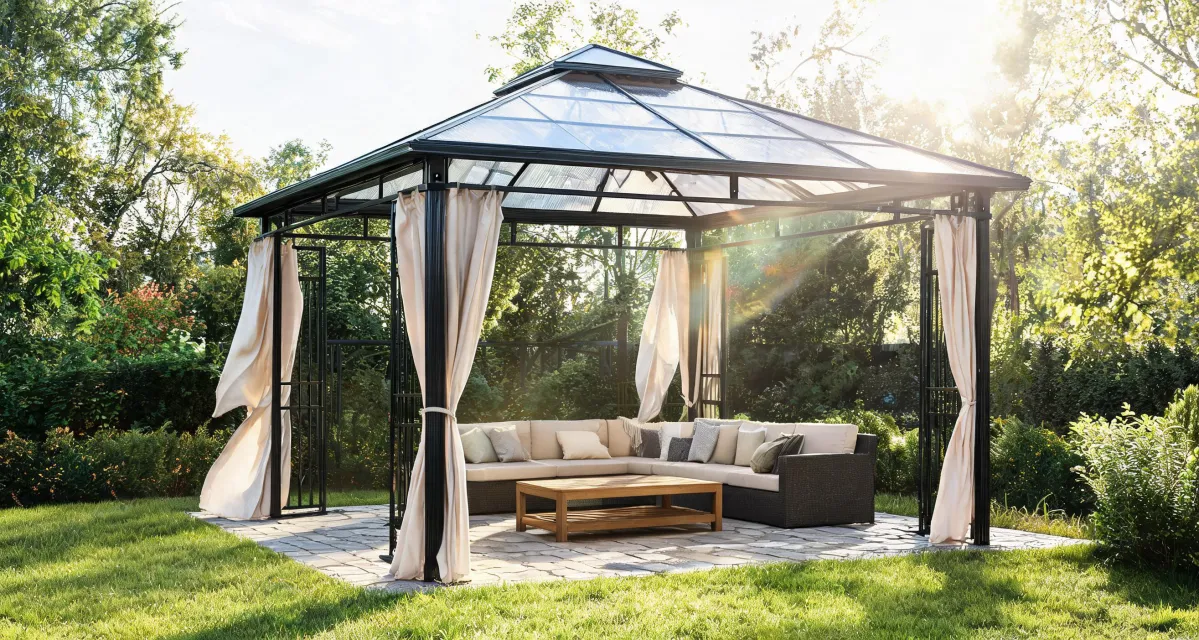
Before you spend on Sojag Meridien gazebo curtains, confirm two things: the exact frame size of your model and the way you will anchor the panels. Fabric color and style are secondary. A curtain that matches the eave height and post spacing will shade, block light, and give privacy; one that does not will look off and catch wind. The mounting method matters even more. Hook-only panels lift in a breeze, while bottom weights or a track channel keep them down. So the buying decision is not 'do I like this color' but 'will it fit my frame and stay put in my weather.' Start with the model number stamped on the frame, measure the distance between posts, and note the eave height before you open any product page. With those two numbers in hand, you can narrow the options and avoid the most common return reasons for gazebo curtains.
Check Frame Size and Mounting Before You Choose Curtains
When you shop for Sojag Meridien gazebo curtains, two checks matter more than color or style: the exact frame size and the way you will anchor the panels. Fabric and finish come second. A panel that matches your eave height and post spacing gives shade, blocks light, and adds privacy; one that does not will look wrong and catch wind. The mounting method is even more important. Hook-only panels flutter in a breeze, while bottom weights or a track channel keep them down. So the buying decision is not 'which color do I like' but 'will it fit my frame and stay put in my weather.' Find the model number stamped on the frame, measure the distance between posts, and note the eave height before opening any product page. With those two numbers, you can narrow the options and avoid the most common reasons for returning gazebo curtains.
The brand context supports this. Sojag is a ShelterLogic brand, and the official site lists US-based customer support available seven days a week, along with a replacement cover kit finder and a range of gazebo accessories. That means if you buy the correct size, you have an after-sales path for worn covers or missing parts. It does not mean every curtain size fits every Meridien. The support and replacement ecosystem only helps once the frame dimensions match; the site itself prompts you to use a cover finder or floor frame kit finder, which implies model-specific sizing. A seven-day support line matters when a panel arrives with a missing bracket; you are not left to solve the problem alone. The same pages also list winter gazebo covers and enclosure kits, which tells you the frame accepts seasonal add-ons, so the curtain is one component in a larger system. Use the brand's own tools rather than assuming one curtain fits all. This evidence also tells you that the manufacturer expects long-term ownership: replacement parts exist for canopies and gazebos, so a curtain investment is not a dead end if you choose correctly. The risk of being stuck with no supplier is low, but only after you confirm the frame.
The rest of this guide walks through what the curtains actually do, how to measure the frame, and how to compare mounting styles. You will see why shade, rain, and privacy are the three practical functions, then get a simple measurement workflow and a mounting comparison. The final section gives a clear buy/no-buy rule based on climate, how often you use the gazebo, and your budget. Along the way, the main misread to avoid is treating curtains as a decorative extra. The largest satisfaction drivers are fit and anchoring. Fabric thickness matters less than bottom weights or track channels. Do not expect this guide to settle the question with a color chart; it settles it with a tape measure. If you come away remembering two numbers, make them the post spacing and eave height of your Meridien. That is the core of choosing correctly, and it is the difference between curtains that work for years and curtains that flap, tear, or go unused.
What Curtains Actually Do for a Meridien Gazebo
What do Meridien curtains actually do? Three jobs: shade, rain protection, and privacy. In the late afternoon, low sun hits the side openings and makes a shaded gazebo feel like an oven. A curtain drops the light level and blocks the low angle. A sudden shower: a curtain on the windward side keeps rain from blowing across the seating area, though it is not a wall and will not stop heavy downpour if the curtain is not weighted. Privacy is the quieter benefit: neighbors can see into the patio at night, and a curtain line gives you a visual screen without building a solid wall. In each case, the effectiveness depends on coverage. The curtain must reach from the eave to the bottom rail or be weighted so it does not lift. A curtain that stops short lets light and rain in at the bottom. So the function is real, but it is conditional on fit and hold-down.
The brand's accessory lineup makes the same point. Sojag, under ShelterLogic, sells replacement cover kits for canopies and gazebos, winter gazebo covers, and enclosure kits. The official pages list wall-mounted gazebos, winter covers, and canopies together, which tells you the brand treats the gazebo as a system you maintain rather than a single disposable item. For a curtain buyer, this matters because a Meridien is not an orphan product. If a panel wears out or a future season needs a different type of enclosure, there is a catalog path to replacement parts and accessories. The same pages note that customer support is US-based and available every day, so a sizing question can get an answer from a person instead of a forum. The condition to remember: the ecosystem supports the decision, but it does not replace the need to match the exact model. Use the brand's replacement cover finder with your frame dimensions, and you lower the chance of ordering the wrong panel.
So the real question is not whether curtains can help; they can. The question is which size and which mounting method will survive your specific setup. That turns an abstract 'should I buy' into a concrete 'what do I measure and how do I attach it.' Before you compare fabrics or colors, you need two frame numbers: the distance between adjacent posts and the height from the floor to the eave. On a Meridien, post spacing varies by model, and eave height changes the required curtain drop. A curtain that fits a 10-foot model will not fit a 12-foot model. The mounting also changes the equation: a rod or hook track is easier to install but leaves the bottom loose, while a track channel or weighted hem solves wind lift but requires more parts. The sections that follow give you the exact steps and the trade-offs, so you can make the call with the frame in front of you.
Measure the Frame Before You Compare Mounting
Start by finding the model number. Stamped or printed on the frame, usually on a beam or the roof strut, it identifies the Meridien variant and unlocks the official size chart. Next measure the post spacing: the center-to-center distance between two adjacent corner posts. Take it at the floor and again at the eave, because some frames taper slightly. Then measure the eave height from the finished floor to the underside of the roof edge. Write both numbers down in inches. If the gazebo is not perfectly square, use the smaller dimension for curtain width. These two measurements are what you compare against the product listing's 'fits model' table. A curtain listed as 'Meridien 10' assumes a specific post spacing; if your model is a narrow variant, the same product will gap at the corners. Do not rely on the overall footprint of the gazebo; post spacing is the dimension the curtain rail actually bridges. This condition analysis is the step most buyers skip, and it is the most common cause of a returned curtain.
Now compare mounting styles. Three common types appear on Sojag-compatible curtains: hooks over an existing frame rail, a rod or track channel, and weighted-bottom panels with ties or grommets. Hook-style panels are the easiest to install but the weakest in wind; a gust lifts the fabric and can pop the hook off. A track channel, where the top edge slides into a groove, keeps the curtain aligned and reduces flapping at the top, but it needs compatible hardware. Weighted-bottom panels use a hem with a chain or bar; the weight pulls the fabric down and stops the 'sail' effect. The mounting choice also affects installation time: hooks take minutes, a track channel may require aligning brackets, and a weighted hem adds no extra hardware but needs room to hang straight. For a Meridien that sits in an open backyard, a weighted hem or track is usually the better value than a heavier fabric with no bottom weight. Do not confuse fabric denier with wind resistance. A thick but unweighted panel can still billow; a lighter panel with a bottom chain stays calmer. Compare the mounting first, then look at fabric if the mounting works for your climate.
Watch for the pitfalls that produce regret. The first is assuming a universal size. Meridien models have different eave heights and post spacing, so a 'standard' curtain that fits one frame will gap or drag on another. The second is ignoring the bottom. A curtain that ends an inch above the floor looks neat but lets light and drafts under; one that puddles gathers dirt and wears at the hem. The third is over-tightening tie-downs: pulling a weighted curtain into a rigid line transfers wind force to the fabric and can tear the grommet. Leave a little slack so the panel can move. The fourth is buying for color first. Matching the patio décor is satisfying, but a mismatched size ruins the effect and the budget. If you catch yourself comparing swatches before measuring, stop and go back to the two numbers. That habit is what separates a curtain that works from one that becomes a return.
Buy When Fit and Anchoring Match Your Use
Buy if your use leans toward shade and privacy and you can anchor the panel. That means the gazebo sits in a sunny spot where low sun makes the area unusable, or neighbors are close enough to see in, or summer showers push rain into the sides. You are a strong candidate if you already use the gazebo most weekends and want it usable into the evening. Skip if your gazebo is fully shaded by a tree, isolated from neighbors, and you only use it for dry daytime meals. In that case the curtain adds cost and another surface to maintain. Climate changes the rule too: in a calm region, even a hook-style curtain can be fine; in a windy or four-season area, you need weighted or track mounting. Budget is the third condition: if the correct mounting style plus the right size exceeds what the curtain will add in usable hours, the purchase fails the value test.
Use this rule. Confirm the model and measure post spacing and eave height. If the curtain listing matches those numbers, move to mounting. Choose a weighted or track-mounted panel in a windy zone; choose a hook or rod panel only in a sheltered spot. Then set a value threshold: you should expect the curtain to add at least one or two extra usable hours per weekend, either by blocking evening sun, keeping light rain off the seating, or giving privacy. If that gain is real, the curtain is worth it; if the frame measurement already matches and the anchoring is solid, the remaining variables like fabric color are preference, not risk. Do not buy a curtain that fails either the size or the mounting test, no matter how good the price. The conflict between budget and fear of a bad fit is resolved by checking these two mechanical facts first, because a correctly fitted and anchored curtain removes the most likely reasons it would waste money.
The verdict is straightforward. Sojag Meridien gazebo curtains are worth adding when the frame size matches and the mounting keeps the panels down; they are not worth adding when those two conditions fail. The brand's own support ecosystem lowers the after-sales risk: Sojag lists US-based customer support available seven days a week and sells replacement cover kits for canopies and gazebos. That means a sizing question can be answered directly and a damaged panel has a replacement path, which is the kind of backup you want when the curtain is exposed to weather all season. But that support only helps after you have picked the right size. Use the official size chart, use the cover finder, and choose a mounting style that holds the hem down. If you do, the curtain extends the usable hours of the gazebo and does the job a fixed shade structure cannot do. That is the condition under which the answer is yes.
So the yes/no answer is not about the curtain color; it is about whether your frame measurements and mounting method make the panel stay put and cover the opening.

Ingrid Falk
Ingrid Falk is an outdoor living products analyst specializing in fences, pergolas, gazebos, canopies, greenhouses, shade sails, patio sets, outdoor sofas, and weatherproof cushions. She uses ISO 4892-2 and ASTM G154 weathering methods while comparing UV color change, coating adhesion, corrosion resistance, frame load, joint stability, water shedding, and dimensional movement. Her work helps garden retailers, project buyers, and hospitality operators select structures and furniture suited to wind exposure, climate, installation method, maintenance, and expected occupancy.