The Sojag Messina Galvanized Steel Roof Gazebo: Durable Asset or Rust Magnet?
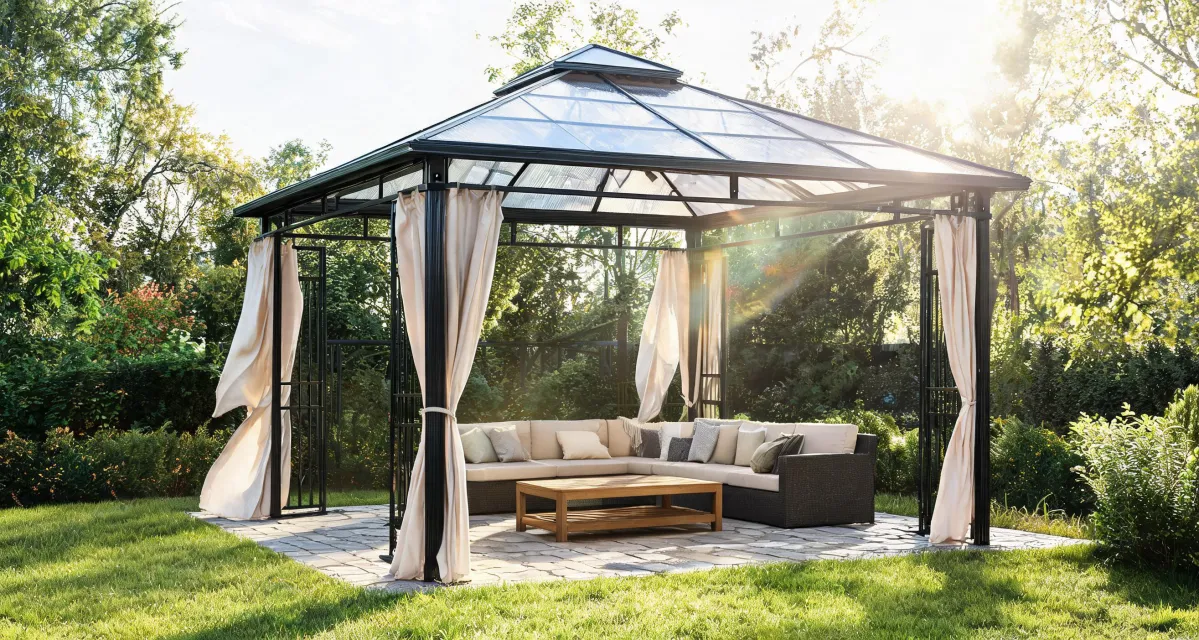
The Sojag Messina's galvanized steel roof is either the smartest long-term investment you'll make for your patio or a rust-prone mistake that will test your patience — and the deciding factor has little to do with the steel itself. Most buyers fixate on whether galvanized steel can outlast polycarbonate or aluminum, but the real battle is between your site preparation and water. This article shows you how to tell which side you're on before you spend the money.
A Galvanized Steel Roof: Your Backyard's Best Friend or a Rust Risk?
Here's the tension: galvanized steel promises the strength of a permanent structure but carries the mental baggage of rust. You've probably seen photos of old steel sheds with orange streaks bleeding down the sides, wondering whether the Messina's roof will eventually look like that. The honest answer is that it can — if you ignore surface scratches, let standing water pool in the seams, or anchor the frame poorly. But that's a failure of ownership, not a flaw in the material. The galvanized coating is designed to sacrifice itself over time, and with the right base and drainage, the Messina's roof can stay clean for a decade or more. The problem is that most reviews blur the line between product failure and installation failure, leaving you with horror stories that don't reflect how the roof actually behaves.
Before you let rust anxiety rule out the Messina, consider what Sojag's own support ecosystem suggests about the product's intended lifespan. It's easy to assume a steel roof will be a headache, but Sojag's official pages tell a different story. The pages advertise US-based support seven days a week, plus replacement covers, winter covers, and roof strengthening kits. That's not the catalog of a company expecting its roofs to fail quickly; it's the toolkit of a manufacturer that plans for decades of outdoor use. For you, this changes the risk equation: if a fastener wears out or a seam needs reinforcement, the parts are available, and you're not left hunting through third-party sellers. The catch is that this support only helps if your base is level and your drainage is right — a wobbly frame will stress the roof no matter how many spare parts you can order. So the support network is a genuine safety net, not a band-aid for a defective product.
The rest of this article follows a simple path to one decision. First, we'll look at the usual complaints — rust spots, noise, leaks — and separate myths from real culprits. Then we'll get into what galvanized steel actually does well and where it needs help, including the boundary conditions that make or break the roof. After that, we'll compare the Messina against polycarbonate and aluminum alternatives, using both material science and Sojag's own product breadth as evidence. Finally, I'll give you a clear verdict: buy it if you can control the three things that matter most, and skip it if you can't. By the end, you'll know exactly where the Messina fits in your backyard.
The Complaints You'll Actually Hear (and What They Really Mean)
When you start reading reviews of steel-roof gazebos, three complaints recur: rust spots on the panels, a drumming noise when rain hits the roof, and leaks around the seams. It's easy to blame the material — 'it's steel, it rusts' — but that misses the point. In most field reports, the rust is localized where the protective zinc layer was scratched during installation or where leaves and debris sat in a low spot, holding moisture against the metal. The noise is real, but it's a function of the panel design and the lack of a solid ceiling, not a sign of failure. And leaks almost always trace back to loosely seated panels or missing washers, not to a defect in the galvanized coating itself.
Many buyers read these complaints and walk away, but they're walking away from a solvable problem. The evidence from Sojag's own site tells us otherwise. The official pages don't just sell the gazebo; they sell the repair side of ownership. You'll find replacement covers, roof strengthening kits, wall-mounted gazebo options, and winter covers — part of a support network with US-based phone assistance seven days a week. If the company expected rust and leaks to be normal, it wouldn't bother engineering reinforcement kits and replacement parts. Instead, the message is that installation and water are the true culprits. A roof that is assembled with panels properly overlapped and fastened, on a base that drains water away, will not give you the classic failure stories. So when you see a one-star review mentioning rust, ask yourself whether the reviewer prepped their base or left the roof covered in pine needles all winter. Think of it as a maintenance map, not a warning label.
The practical takeaway is that maintenance, not the material, decides how many seasons your Messina roof survives. Galvanized steel needs little, but it does need the basics: keep the surface clear of debris, touch up any deep scratches within a couple of weeks, and make sure water can run off instead of pooling. A simple twice-a-year check — once before winter and once after — is enough to catch the small issues before they become orange streaks. That's a far cry from 'zero maintenance,' but it's also nowhere near the level of care a wooden roof demands. The buyers who end up disappointed are the ones who assumed the steel would look after itself on a crooked, poorly drained site. The roof will reward the person who gives it ten minutes of attention twice a year. That's the whole secret.
What Galvanized Steel Does Right — and Where It Needs Help
To understand why the Messina's roof behaves the way it does, you need to know how galvanized steel works. The steel core is coated with a layer of zinc, and that zinc is the sacrificial hero: when the coating is scratched down to the steel, the zinc corrodes first, protecting the underlying metal from rust. This is why minor surface scratches — the kind you get when a branch scrapes across the roof during assembly — are not a death sentence. The zinc oxide that forms in that scratch seals the area and slows further corrosion. The material only becomes vulnerable when a scratch is deep enough to expose bare steel for a long time, or when water sits in a pool against the cut edge for months. In normal atmospheric conditions, a well-maintained galvanized roof can last decades, which is why so many agricultural and industrial buildings use the same coating.
That's the material in a vacuum, but you don't buy a roof in a vacuum. The galvanized roof's real strength is the network around it. Sojag's parent company, ShelterLogic, describes itself as a global leader and innovator of outdoor products, and the depth of that organization shows up in the accessories built around the Messina. For cold regions, Sojag offers roof strengthening kits and winter gazebo covers, designed to help the steel roof survive snow loads and ice dam stress. These add-ons show the brand expects demanding climates and provides the engineering to back it up. For the buyer, this means you're not limited to the roof as it ships. You can add a strengthening kit before the first snow, or fit a winter cover that keeps the panels from being buried. That support infrastructure is a meaningful argument for choosing galvanized steel over a bare polycarbonate sheet, because it gives you a cheap insurance policy against the material's main weakness.
But there are limits. The galvanized coating self-heals minor scratches, not deep gouges. If you drag a ladder across the roof and gouge the steel, it will rust unless treated with zinc-rich paint. The same goes for the cut edges if you modify the panel — those edges are where corrosion starts. Drainage is the other gate: the roof panels need a slope, and the frame must sit level so water doesn't collect in the valleys. Snow load is a third condition; the standard roof is fine for moderate snow, but if you live where storms dump several feet, you should invest in the strengthening kit. Ignore any of these and the stainless promise of galvanized steel turns into a maintenance headache. Respect them, and the roof will behave as advertised.
Messina vs. the Alternatives: How to Decide
Now the comparison you've been waiting for: how does the Messina's steel roof stack up against alternatives? Steel wins on durability and perceived value. It holds up to hail, wind, and heavy snow far better than polycarbonate, which can crack or sag under accumulation. Steel also gives you that permanent, substantial look that polycarbonate lacks — the roof feels like part of a real structure. Against aluminum, steel usually wins on price: aluminum is lighter and never rusts, but it costs more and can dent. Steel is heavier, which is actually an advantage in high wind because it keeps the gazebo anchored. On the downside, steel is noisier in rain and heavier to install, and it needs the zinc coating to stay intact. If your top priorities are silence, zero rust, and the lightest possible structure, aluminum is tempting. But if you want strength and value for a backyard that sees real weather, steel earns its place.
Sojag's pricing and product breadth tilt the comparison even further. The official site shows limited-time savings of up to 60% off select structures, often landing the Messina in a price bracket that undercuts aluminum gazebos by a serious margin. That's not just a sales gimmick; it reflects the economics of a manufacturer that produces a full ecosystem — carports, sheds, greenhouses, and a dozen gazebo lines — under one roof. When you buy the Messina, you draw on that scale, meaning better parts availability and more competitive pricing than a niche aluminum brand can offer. The takeaway for your decision: if your budget is tight and you live in a snowy climate, steel gives you more performance per dollar than aluminum, and the frequent promotions make it even harder to justify the premium for aluminum's lighter weight. On paper, the value math is hard to beat.
The final narrowing comes down to your specific site and climate, not the roof's spec sheet. As part of ShelterLogic — a company that describes itself as a global leader in outdoor products — the Messina is built to a standard that holds up across many weather conditions. But even the best build fails when the ground under it isn't ready. The single most important question is whether your patio is level and drains water away from the base. Second is your climate: if you get heavy snow, plan for the strengthening kit; if you live near the ocean, the salt air will attack the steel and the finish will demand far more attention. When you combine those site factors with your budget, the choice becomes clear. The Messina's galvanized steel roof is not a universal answer, but for a well-drained, level lot in a cold-weather region, it is the value pick among the three roof types.
The Verdict: Buy It If You Can Control These Three Things
Here's my verdict, and it's conditional. Buy the Sojag Messina if you have a level, well-draining base and you're willing to do a simple maintenance check twice a year. The galvanized steel roof will reward you with years of protection against snow and wind, and Sojag's support ecosystem — including roof strengthening kits and replacement covers — makes the long-term risk manageable. The official pages confirm that the brand expects these structures to be used for a long time, and that's a real safety net. However, do not buy it if you want a zero-maintenance structure, or if you live in a highly corrosive coastal environment where the salt air will eat into even the best zinc coating. In those situations, aluminum is worth the extra money. And if your site is sloped or has poor drainage, fix the ground first; no roof will perform well on a crooked frame.
So here's the rule of thumb to take with you. Before you order the Messina, walk your patio with a level and a hose. If water doesn't pool and the ground is flat, you've cleared the biggest hurdle. Then ask yourself whether you're the kind of person who can spend fifteen minutes twice a year clearing leaves and touching up scratches. If you said yes to both, the galvanized steel roof is a smart, durable choice that will outlast a polycarbonate roof and deliver more value than aluminum. If you said no to either, keep shopping, because the Messina isn't the problem — the fit between the product and your site is. The roof is only as good as the ground it stands on, and that's a condition you control.
Let your site, not the hype, make the final call.

Ingrid Falk
Ingrid Falk is an outdoor living products analyst specializing in fences, pergolas, gazebos, canopies, greenhouses, shade sails, patio sets, outdoor sofas, and weatherproof cushions. She uses ISO 4892-2 and ASTM G154 weathering methods while comparing UV color change, coating adhesion, corrosion resistance, frame load, joint stability, water shedding, and dimensional movement. Her work helps garden retailers, project buyers, and hospitality operators select structures and furniture suited to wind exposure, climate, installation method, maintenance, and expected occupancy.